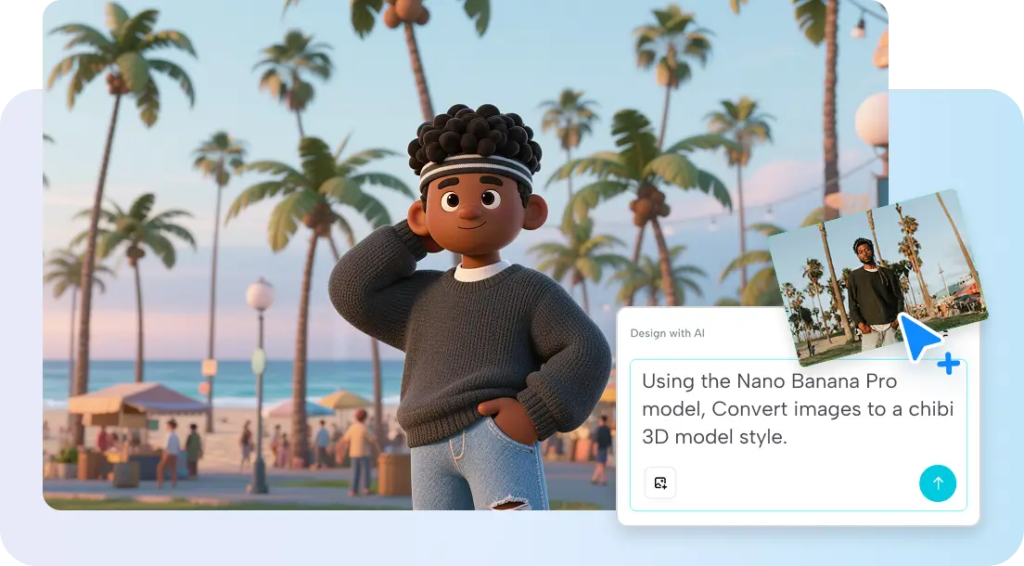
The landscape of digital creativity is undergoing a seismic shift, driven by the rapid evolution of artificial intelligence. Not long ago, creating a specific visual required either advanced manual illustration skills or a stroke of luck with stock photography. Today, the process has become far more collaborative between humans and machines. One of the most groundbreaking developments in this space is the image to image ai technology, which allows creators to use an existing picture as a structural or stylistic blueprint to generate entirely new visuals. This isn’t just about filtering a photo; it’s about reimagining the very essence of an image through the lens of artificial intelligence.
Understanding the Mechanics of Generative Transformation
At its core, the concept of image to image generation relies on complex neural networks that have been trained on billions of visual data points. Unlike “text-to-image” prompts, which start from a blank canvas and rely solely on written descriptions, this method provides the AI with a reference point. By uploading a base photo, you provide the AI with a “map” of composition, lighting, and subject placement.
When you utilize an image to image ai workflow, the software analyzes the shapes and contours of your original file. For example, if you upload a rough sketch of a mountain range, the AI can interpret those lines and transform them into a photorealistic landscape, complete with snow-capped peaks and reflective lakes. This capability bridges the gap between imagination and execution, allowing those who may lack traditional drawing skills to produce professional-grade conceptual art.
Enhancing Creative Workflows for Designers and Artists
For professional designers, time is often the most scarce resource. The traditional “mood board” phase of a project can take days of searching for the right references. With the help of image to image technology, a designer can take a simple smartphone snap of a product and instantly generate dozens of stylistic variations. You can turn a daylight scene into a neon-drenched cyberpunk aesthetic or transform a modern portrait into a classic oil painting style in seconds.
CapCut’s integration of these tools has made high-end generative art accessible to the average user. By choosing to use an image to image ai, creators can bypass the tedious hours of manual masking and texture overlaying. The AI handles the heavy lifting of blending textures and maintaining anatomical correctness, while the human creator retains control over the creative direction through prompts and reference strength settings.
The Versatility of Style Transfer and Structural Guidance
One of the most exciting applications of this technology is “style transfer.” This allows you to take the structural integrity of one photo and apply the artistic “flavor” of another. If you have a portrait that you love but want it to look like a 3D animation character or a vintage comic book illustration, the image to image process makes this possible.
CapCut’s platform offers a user-friendly way to experiment with these styles. By adjusting the similarity settings, you can decide how closely the AI should stick to your original photo. A high similarity score keeps the output very close to the source, which is perfect for subtle artistic enhancements. A lower similarity score gives the image to image ai more creative freedom to “hallucinate” new details, often leading to surprising and inspiring results that a human artist might not have conceived on their own.
Applications in Marketing and Social Media
In the realm of social media, standing out requires constant visual innovation. Influencers and brands are increasingly turning to AI to create “thumb-stopping” content. Instead of posting a standard selfie, an influencer might use an image to image ai to transform themselves into a character from a fantasy realm or a futuristic sci-fi setting. This level of customization creates a unique brand identity that is difficult to replicate with standard editing tools.
Furthermore, the image to image function is incredibly useful for e-commerce. A brand can take a single photo of a model wearing a basic t-shirt and use AI to generate different backgrounds or even change the fabric’s pattern without needing a second photoshoot. This dramatically reduces production costs while maintaining a high standard of visual storytelling.
The Ethical and Practical Benefits of AI-Driven Creation
Beyond the pure aesthetic appeal, using an image to image ai offers practical benefits in terms of copyright and originality. Since the AI is generating a new image based on your unique reference photo and specific text prompts, the resulting output is a one-of-a-kind creation. This reduces the reliance on overused stock images that appear on thousands of other websites, giving your project a sense of exclusivity.
CapCut has focused on making these complex mathematical processes feel like an intuitive part of the creative journey. The interface doesn’t overwhelm the user with technical jargon; instead, it focuses on the “what if” scenarios. What if this photo was a charcoal drawing? What if this room was decorated in a minimalist Scandinavian style? The image to image tool provides the answer almost instantly.
Conclusion: Embracing the AI-Powered Future
As we move further into 2026, the distinction between “AI-generated” and “human-created” art is becoming less relevant than the quality of the final vision. Tools like the image to image ai are not replacements for human creativity; they are powerful amplifiers. They allow us to iterate faster, dream bigger, and produce visuals that were once physically impossible to capture.
By mastering the nuances of image to image generation, you are future-proofing your skill set in an increasingly visual world. CapCut’s commitment to providing these advanced “Magic Tools” for free ensures that the next generation of digital artists will have no limits on what they can create. Whether you are a professional looking to speed up your pipeline or a hobbyist exploring new artistic horizons, the power to transform reality is now just a prompt away.