Most players grind for hundreds of hours and never stop to ask why their focus falls apart in ranked. Not because they lack skill—but because they’re treating attention like a fixed stat instead of something trainable.
Here’s what the science actually says: action and competitive games rewire your brain’s attention networks over time, improving reaction speed, processing, and the ability to filter out irrelevant noise.[1] Focus isn’t a personality trait. It’s a skill. And like any skill, the right training environment determines how fast it develops.
This guide covers everything serious players need—setup, sleep, mental frameworks, break routines, and tools—drawn from current esports performance research.
What Science Says About Gaming and Focus
A 2023 review confirmed that action video games sharpen visual selective attention—specifically your brain’s ability to lock onto targets and filter out distractions simultaneously.[1] Multiple genres show this effect, not just shooters, meaning consistent play builds broader attentional capacity across the board.[2]
Neuroimaging studies in young gamers found greater activity in regions tied to working memory and sustained attention.[5] That’s the upside.
The caveat: heavy, compulsive play without structure can actually degrade attention control over time.[8] The difference between a player who improves and one who plateaus is almost always intentionality. Mindless queue after queue doesn’t build focus—it just burns it.
The takeaway: treat focus like a trainable stat with diminishing returns past a certain session length, not something you earn by playing more hours.
Build a Focus-First Gaming Setup
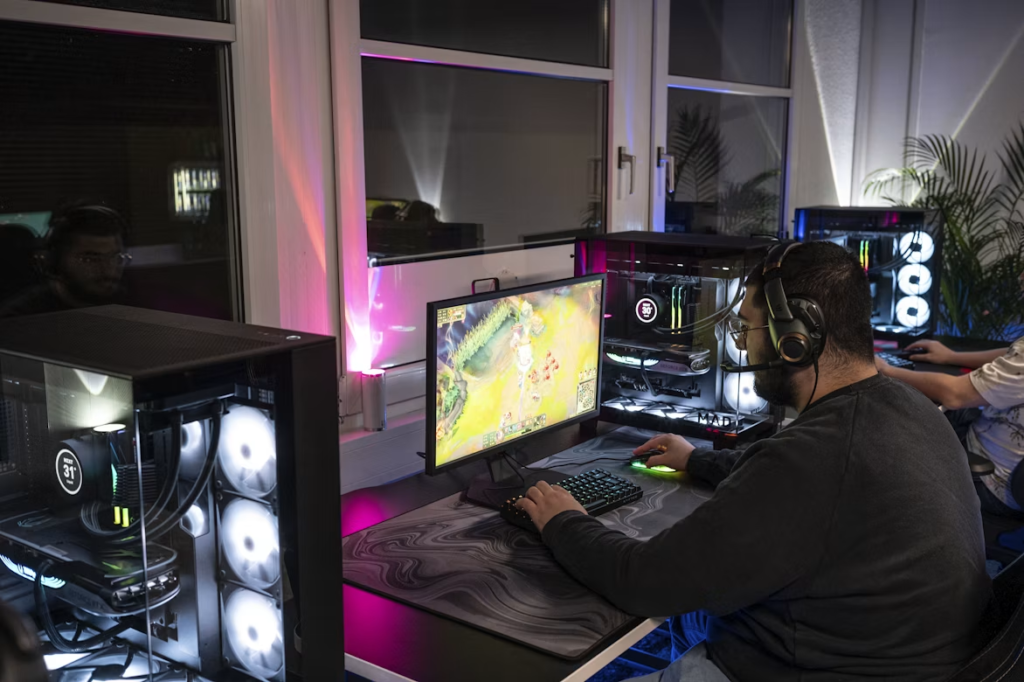
Your environment is quietly taxing your cognitive bandwidth every single session. A poor ergonomic setup is the hidden FPS drop that no hardware upgrade will fix.
Start with posture. Back supported, eyes level with the top third of your monitor, feet flat on the floor, wrists straight, arms resting lightly on armrests. This isn’t comfort advice—neck and shoulder tension actively impairs breathing depth and reaction time during long sessions.
Monitor placement matters too. Position the screen roughly arm’s length away, directly ahead, with an adjustable mount so you’re never craning or tilting. Keep ambient light behind or beside the monitor rather than playing in total darkness—your eyes constantly adjusting to the contrast creates fatigue faster than most players realize.[10]
Emerging research on esports athletes also shows poorer spine posture and mobility compared to non-athletes, which reinforces why proactive setup work protects both your health and your in-game performance long-term.
Sleep, Food, and Hydration: Your Hidden Aim Buffs
No mental strategy outperforms a well-rested brain. Studies in esports athletes directly link poor sleep quality to worse performance on cognitive tasks tied to in-game decision-making, slower reaction times, and weaker impulse control—exactly what you don’t want in clutch rounds.
Target 7–9 hours with a fixed wake time. Cut caffeine several hours before bed. The wind-down routine away from bright screens isn’t optional if you’re serious about performance.
Nutrition audits of high-level esports athletes reveal a pattern: skipped meals, excessive energy drink reliance, and deficits in protein, vitamin D, B-vitamins, and minerals like selenium—all correlated with weaker attention scores.[research] Supplements like L-theanine paired with moderate caffeine can support alertness and smooth out energy crashes, but they don’t fix a garbage diet. Basic nutritional quality always comes first.
Hydration is genuinely underrated. A 2024 competition study found roughly two-thirds of esports players arrived dehydrated at live events. Even mild dehydration shrinks brain tissue volume and impairs short-term memory and decision-making.[research] Keep a water bottle at your setup. Use the gap between ranked games as a hydration checkpoint. Around 6–8 glasses a day is a solid baseline.
Mental Game: Pro-Level Psychological Strategies
Elite players don’t just aim better—they manage their attention deliberately under pressure.
Present-moment focus is the core skill. Pros specifically talk about ignoring the name or rank on the enemy side to avoid intimidation-based tilt.[6] What matters is your gameplay, your positioning, your comms—not who you’re playing against.
British Esports performance guidelines recommend setting SMART goals for each practice block rather than just queuing with a vague “try harder” mindset. Something like “track ward placement in 80% of games” beats “communicate better” every time—it’s specific, measurable, and keeps attention anchored during the session.
Pre-match routines also matter more than most players admit. A short breathing exercise (box breathing: inhale 4 seconds, hold 4, exhale 4), one key focus cue reviewed before the match, and a clear objective for the session all reduce the mental clutter that spills into early-game mistakes.
Post-match, pull one or two clips of mistakes and one or two clips of good plays. Ask one improvement question. Then stop. Endless self-criticism after losses is tilt in slow motion—it doesn’t build skill, it just erodes confidence.
Gear, Ergonomics, and Eye Health
Hardware affects focus in ways that go beyond frame rate. An ergonomic chair with lumbar support, adjustable height, and proper armrests makes it physically easier to maintain neutral posture across a full session. Repetitive strain injuries from poor keyboard and mouse positioning develop slowly and silently cap mechanical skill long before most players notice them.
For eye health, the 20-20-20 rule is the simplest evidence-backed habit: every 20 minutes, look at something 20 feet away for 20 seconds.[10] Blue light filtering glasses or built-in night modes can reduce perceived eye strain after extended sessions and support sleep quality after late-night play.[7]
Match your screen brightness to ambient room lighting. Blink consciously during tense rounds—players in high-focus states blink significantly less, which accelerates dryness and blurred vision.
Breaks, Tilt Control, and Digital Wellness
Breaks are not wasted grind time. Research on prolonged sitting shows that five minutes of walking after an hour of sitting reverses blood pooling and measurably improves circulation and cognitive performance. Applied to gaming, this maps directly to the gap between matches.
A pro-style break routine after every 30–40 minute match takes under five minutes:
- Two minutes of light movement—walk around, do a few squats or toe touches to boost blood flow
- One to two minutes of box breathing to reset focus and reduce carry-over tilt
- Water plus a light snack like nuts or fruit instead of high-sugar junk that spikes and crashes energy
Digital distractions are just as costly as physical ones. Mute non-essential notifications, close unnecessary browser tabs, and put your phone on do-not-disturb during ranked or scrims. Attention is a finite resource per session—every Discord ping or Twitter reflex is a small withdrawal from that account.
Tools and Training Systems to Sharpen Attention
Aim trainers like Aim Lab and Kovaak’s function as gyms for visual attention and motor control—structured drills targeting tracking, flicking, target switching, and click timing. The key is treating them like deliberate practice, not just warming up mechanics mindlessly.
Newer AI-driven tools like Aimbeast emphasize quality reps and technique feedback, making improvements measurable across weeks rather than relying on vague feelings of improvement.
Time-blocking for practice sessions reduces decision fatigue mid-day. Knowing exactly what you’re working on—warm-up, mechanics drills, ranked, VOD review—keeps focus anchored on the current task instead of bouncing between priorities. Many top players now use the same calendar tools as traditional athletes to structure their training weeks.
Windows Focus Assist, Discord streaming modes, and equivalent console features exist specifically to silence pop-ups during competitive play. Use them. For players who want an additional performance edge during sessions, resources like those available via Battlelog offer tools designed to sharpen situational awareness and in-game performance.
Pro Routines You Can Steal Today
The shift from chaotic all-day queuing to a structured session makes a measurable difference. A practical daily framework for a serious ranked grinder looks like this:
15–20 minutes: Aim trainer warm-up, focusing on one specific drill (tracking or clicking, not both)
2–3 ranked games: One clear focus objective per session, tracked mentally or noted down
5-minute break: Movement, water, breathing reset
VOD review: One improvement question, two clips maximum, one actionable lesson written down
Physical training five to six times a week, consistent meals, and around a gallon of water daily are habits credited by multiple professional players with improving both practice quality and mental resilience under pressure. The body and the brain aren’t separate systems. Training one neglects the other at a real cost to performance.
Focus isn’t something you either have or don’t. It’s the output of everything covered here—your setup, your sleep, your nutrition, your mental habits, and how deliberately you structure each session. Build the system first. The results follow.