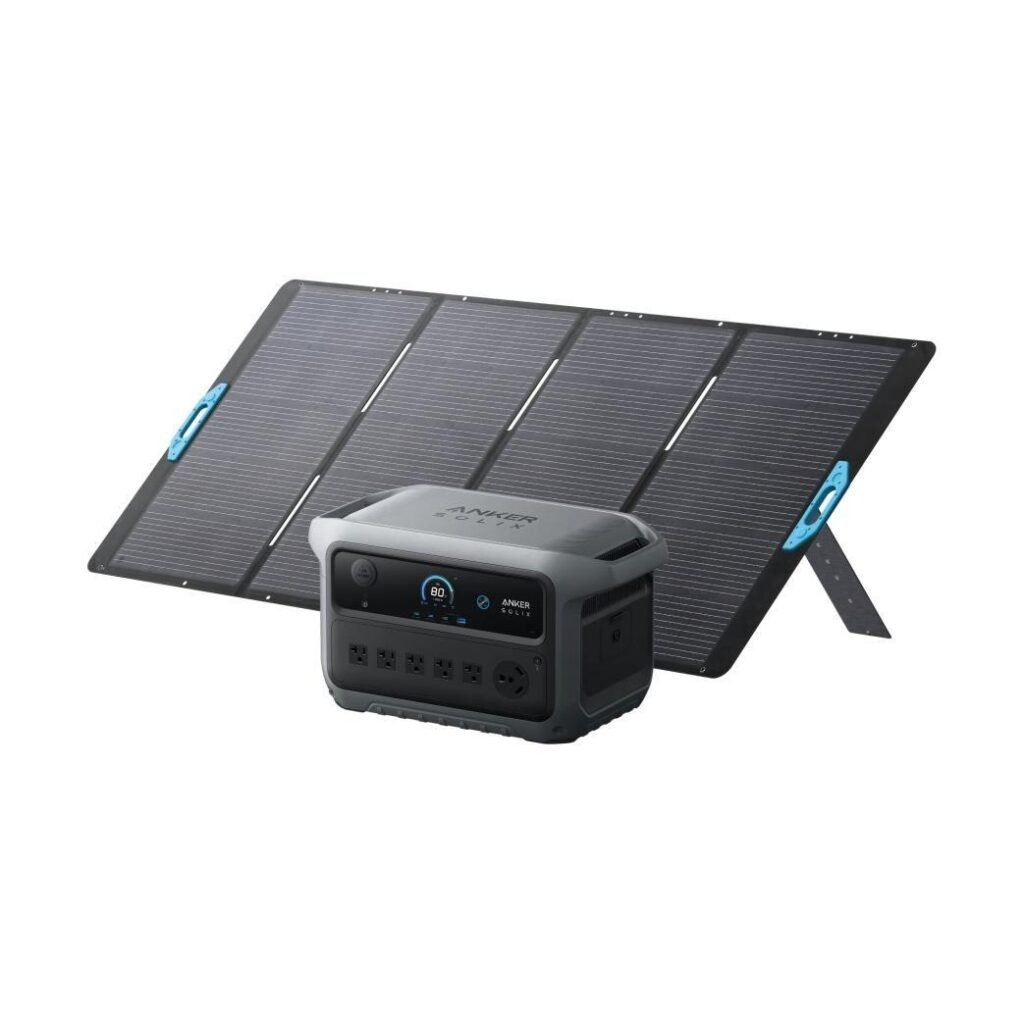
Homes often miss the correct generator size because real-world energy habits rarely match what homeowners assume about their usage. People typically think backup power decisions revolve around square footage or a simple wattage estimate, but daily behavior, appliance cycling, and seasonal routines matter far more. Misjudging any of these factors can produce a system that is too small to support essential appliances or unnecessarily large for what the household truly needs. Understanding these mistakes helps homeowners make smarter choices and figure out how many kw generator to run a house without wasting money or compromising performance. Solar-based systems such as the Anker SOLIX C2000 Gen 2 with a 400W solar panel offer flexible capacity and predictable output, making it easier to size correctly from the start.
Why Sizing Expectations Often Fail Before Installation?
Overestimating or Underestimating Actual Appliance Loads
Many homeowners rely on appliance labels or online charts to estimate generator loads, but these numbers rarely reflect true usage patterns. For instance, refrigerators or HVAC units have surge cycles that temporarily draw far more power than their listed wattage. People who only add up running watts typically end up with an undersized generator that cannot handle real surges. Conversely, some homeowners assume every appliance must run simultaneously, so they oversize dramatically. Solar generators help bridge this gap because their peak power capacity offers protection during temporary surges while maintaining efficient power delivery during normal use. The C2000 Gen 2 delivers up to 4,000W peak, allowing it to support brief spikes without forcing homeowners into oversized systems.
Ignoring Lifestyle Patterns That Affect Load Demand
Backup power usage depends heavily on how people live, not just what they own. Busy households may rely on multiple high-demand appliances during morning and evening routines, while smaller households use far less energy in overlapping periods. If homeowners size a generator based on theoretical maximums rather than real-life behavior, they misalign needs with capacity. Solar solutions simplify the process because they provide runtime data, efficient idle consumption, and the option to add a BP2000 expansion battery for up to 4kWh total capacity. This helps homeowners match output to lifestyle rhythms instead of guessing based solely on wattage charts.
Relying on Floor Area Instead of Load-Specific Requirements
A common misconception is that two homes of similar size require the same generator. This assumption leads to frequent sizing mistakes, because energy consumption depends on insulation quality, number of occupants, appliance mix, and climate conditions—not square footage. One household may have a high-demand HVAC system, while another may rely primarily on efficient electric heaters. A solar generator avoids this mismatch because it does not attempt to power an entire home by default; instead, it prioritizes essential circuits and enables users to allocate capacity intentionally. With the C2000 Gen 2 powering a dual-door fridge for up to 32 hours, homeowners can build a reliable baseline without oversizing.
How Misinformation and Outdated Rules Influence Wrong Sizing?
Trusting One-Size-Fits-All Generator Charts
Many generator recommendation charts oversimplify the process by offering general size categories for homes instead of analyzing real load behavior. They may suggest a single generator wattage for all outages, ignoring the differences between short outages, extended outages, and emergencies where solar recharging becomes crucial. These charts also rarely address fuel consumption, noise, or long-term operating behavior. Solar generators introduce a more flexible model. The 400W solar panel paired with the C2000 Gen 2 recharges efficiently at up to 23% conversion efficiency, extending runtime without forcing users to overspecify initial capacity the way traditional guidelines often do.
Not Accounting for Seasonal or Environmental Variability
Homes in hot climates experience massive summer surges from air-conditioning cycles, while cold regions see higher winter heating loads. Yet many homeowners size a generator based on a single season or an average number that fails under extreme conditions. Incorrect assumptions about solar availability also lead people to misjudge what their systems can handle. Adjustable solar angles—30°, 40°, 50°, and 80°—on the PS400 panel allow users to maximize solar harvest year-round, making capacity more predictable. This reduces the risk of choosing a generator that only meets demand during mild months.
Misunderstanding What Backup Power Should Actually Cover
A major sizing failure occurs when homeowners try to make a backup system mimic full grid service. They assume a generator must run everything at once: laundry machines, HVAC, entertainment systems, cooking appliances, and chargers. In reality, most outages require only essential loads such as refrigeration, communication devices, and limited climate control. When people misunderstand what matters during real outages, they choose unnecessarily large units that waste resources. Solar generators promote clearer decision-making because their battery-based architecture encourages prioritization. The C2000 Gen 2, with six ways to recharge and low idle consumption at 9W, supports this efficient and realistic backup model, while also helping homeowners answer how many kw generator to run a house based on essential loads rather than unrealistic full-home assumptions.
Conclusion
Homes end up with the wrong generator size because many decisions are made using assumptions instead of real load data, lifestyle behavior, seasonal patterns, or appliance cycling. Charts oversimplify, wattage labels mislead, and outdated rules ignore the flexibility needed for today’s energy habits. Choosing the right size requires understanding how a household actually consumes electricity and what matters most during an outage. Solar generators such as the Anker SOLIX C2000 Gen 2 with a 400W solar panel give homeowners adaptable capacity, fast recharging, and efficient performance, reducing the risk of oversizing or undersizing. With thoughtful planning and accurate usage insights, homeowners can select the generator size that truly fits their needs with confidence.