Events are the operational equivalent of a surgical procedure: the preparation happens over weeks or months, the execution happens in hours, and the cost of discovering a problem during execution is orders of magnitude higher than the cost of preventing it during preparation. The event management team that discovers on the morning of a conference that a supplier confirmation was never received, that a venue change was not communicated to all the speakers, or that the registration list in one system does not match the guest list in another has no good options remaining. The flawless event is not the product of a more talented event team. It is the product of an event management infrastructure where every confirmation has been received and logged, every change has been communicated to every relevant party, and every list has a single source of truth that every team member is working from simultaneously. Building that infrastructure requires project management tools that handle the complexity of multi-vendor, multi-venue, multi-day event coordination without the manual overhead that scale typically generates.
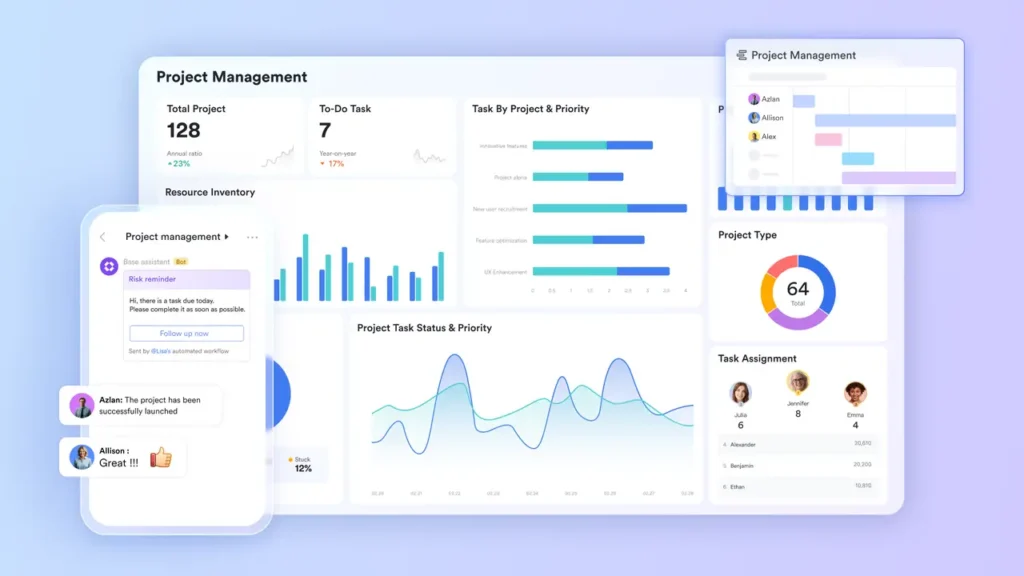
A single operational dashboard for every event element with Lark Base
The event management spreadsheet that contains every vendor, every timeline, every confirmation status, and every contingency is the most common event management tool and the most reliable source of event management failures. It has no automation, no real-time collaboration, and no way to present different views to the different team members who need different perspectives on the same underlying data.
- Gallery view allows the event team to display visual assets, venue layouts, speaker profiles, and sponsor materials as a visual grid that can be reviewed and approved without opening each file individually, making the pre-event asset review manageable for large-scale events with hundreds of visual elements.
- Gantt view overlays every event element, from venue booking to catering confirmation to AV setup to speaker briefings, on a single timeline that makes schedule dependencies and deadline conflicts visible before they become day-of problems.
- Automated notifications trigger when a confirmation has not been received by a specified deadline, when a vendor has logged an issue, or when a task is approaching its deadline without the preceding dependency being complete, so the event manager receives proactive alerts rather than discovering problems in the final days of preparation.
Vendor and speaker communication that reaches everyone at once with Lark Calendar
Event coordination involves a specific scheduling challenge: communicating schedule changes, venue updates, and logistical requirements to dozens of vendors and speakers simultaneously, in a way that every recipient can confirm receipt and that the event manager can verify has reached everyone it was intended for.
- Lark allows organizers to create meeting groups linked to calendar events, with participants automatically added to a shared communication space. Within the group, teams can share agendas, logistics updates, preparation materials, announcements, meeting notes, and relevant documents before each session. For recurring events, new internal participants added to future sessions can also be included automatically, helping event teams reduce repetitive coordination and keep attendees prepared.
- “Schedule in Chat” allows the event management team to coordinate the scheduling of vendor meetings, speaker briefings, and team coordination sessions directly within the project communication group without the back-and-forth scheduling exchange that consumes significant event management time in the weeks before a major event.
Real-time coordination with every supplier and venue team with Lark Messenger
Event execution requires real-time coordination between multiple teams that may be in different parts of a venue, different venues on the same event day, or different cities for a multi-location event. The communication infrastructure that works for a single-venue, single-day event needs to scale to the multi-venue, multi-day conference without generating the communication overhead that makes large events difficult to manage.
- Lark Base allows event teams to organize and filter tasks, schedules, and operational data by venue, supplier category, or event day, making it easier to focus on specific responsibilities during complex events. Teams can also create meeting groups for participant coordination, helping event managers navigate event operations more efficiently without relying on scattered communication channels.
- “Real-time Auto Translation” across 24 languages supports international events and conferences where venue teams, suppliers, and participants communicate across multiple language backgrounds, allowing the event management team to coordinate in one language while every recipient receives communication in theirs.
- “Scheduled Messages” allow the event management team to push pre-event briefings, day-of logistics updates, and session-specific reminders to every relevant party at the appropriate time without the event manager having to compose and send each communication manually in the middle of managing the event.
Vendor authorization and contract approvals that do not stall the event timeline with Lark Approval
Event management approvals, vendor contracts, budget authorizations, venue change orders, and last-minute scope adjustments, often have time windows that are shorter than the approval cycles of organizations that were not designed with event timelines in mind.
- “Parallel Routing” sends vendor contracts and budget authorizations to every required approver simultaneously, so the event team receives the authorizations they need within the event’s tight timeline rather than waiting for each approver to complete their review before the next begins.
- “Conditional Branches” route different categories of event expenditure and vendor commitment to the appropriate approval authority automatically, so routine vendor confirmations within an approved budget do not require the same approval chain as a last-minute venue upgrade that exceeds the planned expenditure.
- “Approval Notifications” deliver outcomes to the event management team immediately when decisions are made, so the event team can move to the next preparation step without checking back on approval status in the middle of an already demanding pre-event period.
Event documentation that supports flawless execution with Lark Docs
The run-of-show document, the speaker briefing pack, the supplier contact sheet, and the contingency plan are the core documentation artifacts of any major event. When these documents are current, accessible, and consistent, the event team can execute with confidence. When they are scattered across multiple file versions, accessible to some team members and not others, or based on information that has been updated in one place but not reflected in another, the event team manages documentation uncertainty alongside all the other uncertainties that event day brings.
- Real-time co-editing allows every team member to contribute to the run-of-show and the briefing documents simultaneously, so the final version reflects the current knowledge of the full event team rather than one person’s attempt to synthesize everyone else’s inputs.
- “Version History” records document changes with editor names and timestamps, helping event teams verify they are working from the latest version of schedules, run sheets, or planning documents. Users with edit permissions can review previous versions when discrepancies arise, making it easier to trace updates across event documentation. Changes made within certain embedded blocks, such as calendar events, are not included in version records.
- “@mention” within event documents allows the event manager to assign specific logistical responsibilities to team members at the point in the document where those responsibilities are described, creating a natural action assignment structure that is embedded in the operational reference rather than maintained in a separate task system.
Bonus: Why event management tools often create more coordination problems than they solve
The event management technology market is full of specialist tools: event registration platforms, venue booking systems, speaker management tools, and event-specific project management software. Each of these tools handles one dimension of the event management challenge while creating its own coordination overhead at the boundaries with every other tool the event team uses.
The event team that manages registrations in one tool, vendor communications in another, the run-of-show in a third, and supplier approvals through email has not simplified their coordination problem. They have distributed it across four systems that each require separate access, separate updates, and separate maintenance. Teams evaluating Google Workspace pricing often find that collaboration tools alone are not enough for complex event operations. They frequently add separate platforms for event planning, communication, approvals, scheduling, and document management, which can create extra coordination work as information moves between systems. Lark brings operational tracking, calendar coordination, communication, approval workflows, and documentation into one environment, helping event teams reduce friction across those workflows.
Conclusion
Flawless event execution is not the product of an exceptionally talented event team working exceptionally hard. It is the product of an operational infrastructure where every confirmation is tracked, every change is communicated universally, every authorization arrives on time, and every document is current and accessible. A connected set of productivity tools that handles the full coordination complexity of major event management in one environment is how event teams consistently deliver excellent experiences without the operational failures that fragmented infrastructure generates.