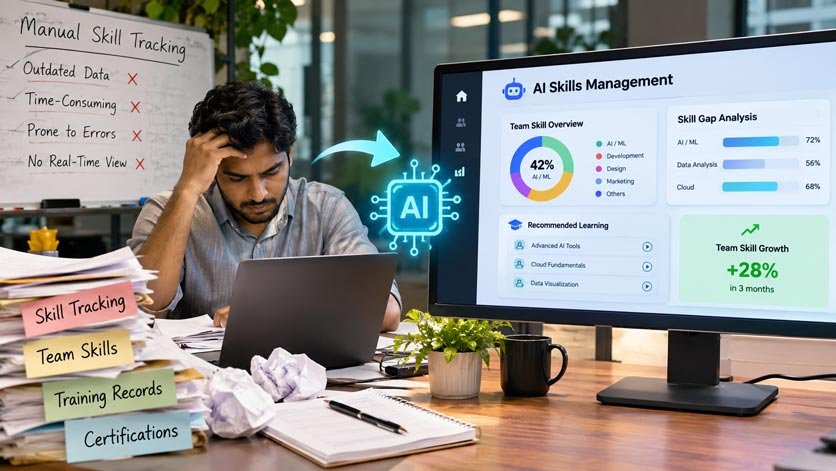
A delivery head needs 40 people who have generative AI and cloud skills for a new client engagement in the organization. But the company’s skills matrix lists 12, and the profiles were last updated a year ago, and nobody knows how many employees have developed these capabilities since then.
This is where manual skills tracking becomes a familiar problem for large enterprises. Skills change faster than spreadsheets, surveys, and periodic assessments can keep up with the information. By the time workforce data is updated, it may already be outdated.
In such a context, AI skills management offers a different approach, where it works on using existing data to build a better picture of the workforce. Rather than relying on employees to maintain static profiles, it builds a more current picture of workforce capabilities.
Here’s how it works, where it adds value, and how organizations can start using it.
Why Manual Skills Management Breaks Down at Scale
Manual skills tracking can work for a small team, but across thousands of employees, multiple business units, and changing project requirements, it becomes difficult to maintain reliable data.
Self-declared profiles go stale fast
Self-declared profiles sit untouched for months, as employees often update their skills profiles during appraisals or when asked by HR. Some employees overstate their proficiency, while others overlook skills gained throughout their work on some recent projects. For this reason, and without regular validation, managers have little basis for knowing which profiles reflect current capabilities.
Skills data is trapped in disconnected systems
Each of the systems, such as your HR systems, learning platforms, and project tools, shares a part of the complete picture. This includes everything from employee records to tracking course completions and project tools showing assignments.
For talent managers, bringing this information together manually for employee skill mapping often means long exports, spreadsheet consolidation, and repeated follow-ups.
Static skills taxonomies cannot keep pace
As existing skills evolve with new capabilities such as prompt engineering, LLMOps, and AI governance emerging, it becomes a struggle for large-scale enterprises and organizations to keep pace. Teams may use different names for the same skill or lack agreed definitions for emerging ones.
The result is a workforce view that is incomplete, inconsistent, and difficult to use for timely decisions in the organization.
What Is AI Skills Management?
AI skills management uses machine learning to infer, validate, and update employee skills from existing workforce data. It connects those skills to decisions about staffing, internal mobility, learning, and workforce planning.
Traditional skills management relies on periodic surveys and self-reported profiles that HR managers used to fill out manually. AI-based approaches use multiple data signals to maintain a more current picture, with employees and managers helping validate the results based on recent information and data.
This creates an operating layer for a skills-based organization, where workforce decisions are guided by demonstrated and developing capabilities, not just job titles.
How AI Skills Management Works: A Four-Layer Model
AI-skills management works in a four-layer process, which includes:
Layer 1: Collecting skill signals
Most organizations already hold useful skills information. It may be spread across resumes, job histories, project assignments, timesheets, certifications, learning records, assessments, and, where appropriate, code repositories or other work artifacts.
AI skills management brings relevant signals together to build a broader view of employee capabilities. The goal is not to collect more data for its own sake, but to make existing information useful within the organization and deploy talent where needed.
Layer 2: Skills inference and proficiency scoring
Skills inference means identifying employee capabilities from actual evidence, even when an employee has not explicitly listed them in their profile.
For example, experience managing Kubernetes environments may indicate familiarity with containerization and DevOps practices. All these related skills can be surfaced for validation rather than assumed to be proven.
In such a context, a useful system also distinguishes between having a skill and being proficient in it. Regular assessments, project experience, and how recently a skill was used can help estimate proficiency. These estimates should remain open to correction when the evidence is incomplete. Skill inference allows hiring managers to estimate and make decisions.
Layer 3: A living skills taxonomy
A skills taxonomy provides a common language that describes capabilities and connects them to related skills, job roles, and tasks.
AI can help hiring managers identify duplicate terms, such as “ReactJS” and “React.js”, and flag emerging skills that may need to be added. This reduces the manual effort required to keep the taxonomy relevant, while allowing specialists to review important changes.
Layer 4: Activating skills data in decisions
A skills profile is useful only when it informs an action. Once capabilities are mapped, organizations can use them to identify project candidates, plan development, support internal moves, and make more informed hiring decisions.
The real value lies in connecting skills visibility to the decisions that shape how work gets done.
Where Enterprises See Value First
Faster, more useful skill gap analysis
Comparing current capabilities with future demand helps organizations identify gaps before they affect delivery. For example, a company that is preparing for a major data migration within six months could identify shortages in data engineering early enough to plan hiring or training.
This helps them take a forward step in skill gap analysis.
Internal mobility and project staffing
When a new project needs specialized skills, external hiring is not the only option. A skills intelligence platform can surface employees whose capabilities closely match the new requirement, including those who may need targeted development before taking on the work.
This helps talent managers shorten the staffing cycles, reduce recruitment costs, and create more opportunities for employees to grow within the organization.
AI readiness and targeted reskilling
Large-scale organizations that are planning to adopt AI in their workforce need to understand which teams have the required capabilities and where additional training is needed. With proper analysis, skills data can help them identify those gaps and connect employees with relevant learning paths.
As a result, instead of assigning everyone the same course, L&D teams can focus on the specific capabilities employees need to develop.
A Practical 90-Day Rollout Plan
AI skills management does not need to begin with an organization-wide transformation. A focused rollout can establish the foundations and demonstrate value.
- Days 1 to 30: Connect and baseline.
Bring together the major data sources, such as the HRIS, project systems, and learning records; this helps you generate an initial view of workforce skills.
- Days 31 to 60: Validate and refine.
Ask employees and managers to confirm, correct, and validate inferred skills, which helps you standardize the taxonomy for priority job families and new requirements. - Days 61 to 90: Activate one use case.
Begin with a clear business need, such as project staffing or internal mobility. Measure the results before expanding to other teams.
When you start with a defined use case, it makes it easier for your team to test data quality, build trust, and demonstrate practical value.
Guardrails to Get Right From Day One
It is important for employees to have visibility into the evidence behind inferred skills and have the ability to correct inaccuracies in their profiles. In large-scale organizations, hiring managers should also actively monitor matching recommendations for bias and retain human sign-off on important talent decisions.
Clear and open communication about how the workforce data is used is equally important, because employees are more likely to trust the process when its purpose and limitations are transparent.
Conclusion
AI skills management shifts organizations from skills data people must continually maintain to skills data that can be updated from ongoing evidence, with human validation where needed.
The best starting point is a single workforce challenge, supported by reliable data and a AI skills intelligence platform that goes beyond surveys. As the approach matures, organizations can build a more accurate view of their capabilities and make better-informed decisions about staffing, development and mobility.
For enterprises working towards a skills-based organization, that visibility is a practical foundation for responding to changing business needs.