The average U.S. electricity customer went roughly 11 hours without power in 2024 — nearly twice the annual average of the prior decade, according to the U.S. Energy Information Administration. Major storms drove most of it: Hurricanes Beryl, Helene, and Milton alone accounted for about 80% of the hours customers spent in the dark. When outages stretch that long, the question stops being whether to buy backup power and becomes which kind actually holds up. U.S. Energy Information Administration U.S. Energy Information Administration
What each one actually does
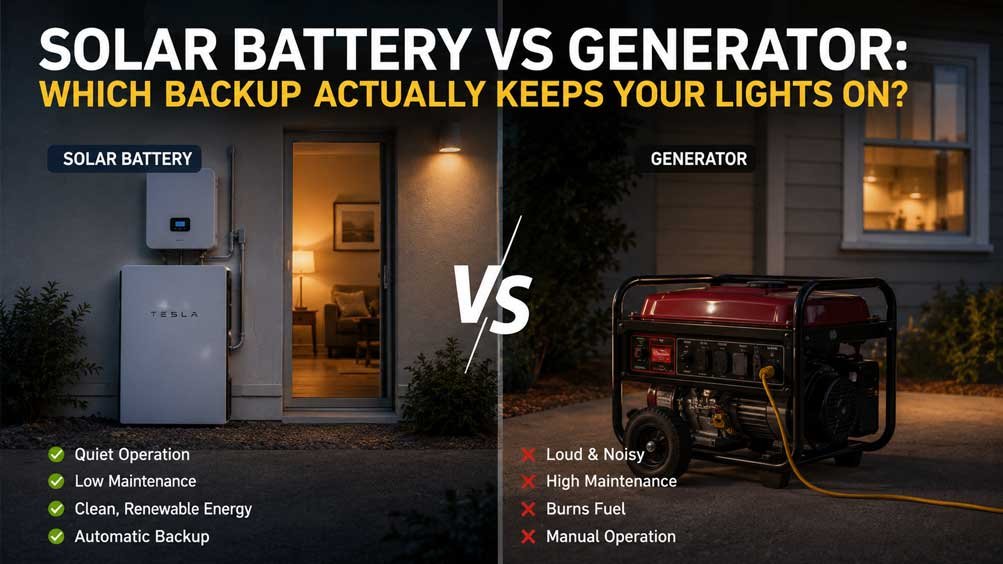
A standby generator is a fuel-burning engine — usually natural gas or propane — that starts automatically when it senses the grid has dropped and runs your home until the fuel or gas supply gives out. A home battery does the opposite: it stores electricity, often from rooftop solar, in a stack of cells and discharges it on demand, with no combustion anywhere in the loop. Both keep the lights on. The differences show up in how they get there.
Most modern solar battery storage setups pair those cells with smart controls, so the handoff from grid to battery happens on its own. Many use lithium iron phosphate (LFP) chemistry — a battery type prized for staying thermally stable and not off-gassing under stress.
Speed and safety tilt toward batteries
Speed matters more than buyers expect. A standby generator usually needs several seconds to detect an outage, crank its engine, and transfer the load — long enough for a desktop to die mid-file or a router to reboot. A battery paired with dedicated backup hardware can switch over in milliseconds, fast enough that sensitive electronics never register the grid left. That same controller can also decide which circuits get backed up first, running the fridge and well pump while shedding the hot tub, so a modest battery stretches a lot further.
Then there’s the part nobody likes to think about. Portable and poorly vented generators carry a hazard batteries don’t: carbon monoxide. The Consumer Product Safety Commission estimates that about 100 people die each year in the U.S. from CO poisoning tied to portable generators, and weather-related power outages are the most common reason those generators were running in fatal incidents. The agency notes a single portable generator can emit as much carbon monoxide as hundreds of cars. A sealed battery on an exterior wall produces no exhaust at all.
A quick side-by-side
| Factor | Standby generator | Solar battery |
| Startup time | Seconds | Milliseconds |
| Fuel / recharge | Gas line or stored propane | Solar plus grid, no fuel |
| On-site emissions & noise | Combustion, audible | None, silent |
| Long-outage runtime | As long as fuel lasts | Capacity-limited, recharges by day |
Where each one wins
Neither is strictly better; they win under different conditions. A generator earns its keep during a week-long winter outage with little sun and a propane tank you can keep topping off. A battery earns its keep the other 360 days a year, storing cheap or solar power and trimming peak-rate electricity off the bill — value a generator can’t add. Households in storm-prone areas sometimes run both, letting the battery cover the first several hours silently and a generator step in only if the outage really drags on.
One footnote on the headline numbers: those outage hours count only interruptions lasting longer than five minutes, the threshold defined by IEEE standards — so the real disruption to daily life is often longer than the averages suggest.
For most homeowners, the deciding factor turns out to be less about the cells themselves and more about the controls sitting between the battery and the breaker panel — what gets backed up, how fast, and for how long. Sigen’s LoadHub is built for exactly that handoff, and it’s a useful yardstick for how seamless modern battery backup has gotten.