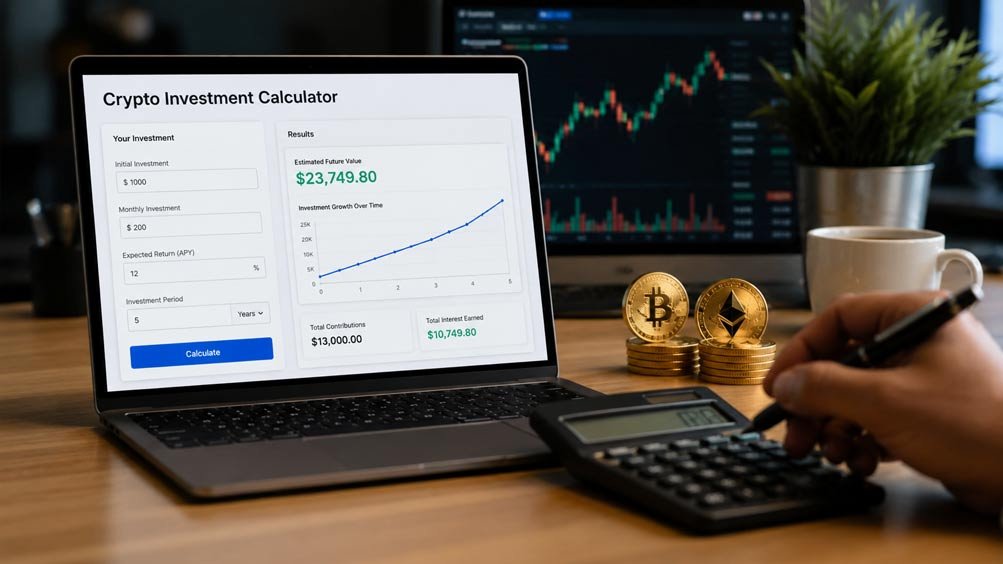
Buying cryptocurrency is easy. Keeping track of several purchases made at different prices is where things become confusing. A practical tool such as https://iamforextrader.com/en/tools/crypto-averaging-calculator/ can help you combine multiple transactions and calculate the average entry price of a position without building a complicated spreadsheet.
This is useful for anyone who buys Bitcoin, Ethereum or another digital asset in several stages. Instead of looking only at the latest market price, you can see how much you have invested, how many coins you hold and the price at which your total position would approximately break even before fees.
This guide explains how a crypto investment calculator works, what information you need to enter and which common mistakes can make the result less accurate.
What Is a Crypto Investment Calculator?
A crypto investment calculator is a digital tool that processes information about your cryptocurrency purchases.
Depending on the tool, it may calculate:
- Your average purchase price;
- The total quantity of cryptocurrency purchased;
- The total value invested;
- The difference between the current price and your average entry;
- A hypothetical profit or loss;
- The effect of adding another purchase;
- An estimated liquidation level for a leveraged position.
The main advantage is convenience. While the same calculations can be completed manually, errors become more likely when a position contains five, ten or even twenty separate transactions.
“A useful calculator does not predict the market. It simply makes the numbers behind your decisions easier to understand.”
That distinction is important. A calculator can organize information, but it cannot tell you whether an asset will increase or decrease in value.
How Average Entry Price Works
Suppose you buy the same cryptocurrency three times:
| Purchase | Coin Amount | Entry Price | Purchase Cost |
|---|---|---|---|
| First buy | 0.010 BTC | 60,000 USDT | 600 USDT |
| Second buy | 0.015 BTC | 56,000 USDT | 840 USDT |
| Third buy | 0.005 BTC | 52,000 USDT | 260 USDT |
| Total | 0.030 BTC | — | 1,700 USDT |
Your average entry price is not the simple average of 60,000, 56,000 and 52,000. That would ignore the different amount purchased in each transaction.
Instead, the calculation is weighted by the quantity bought:
Average entry price = Total purchase cost ÷ Total coin amount
Using the figures above:
1,700 ÷ 0.030 = 56,666.67 USDT
Your approximate average entry price is therefore 56,666.67 USDT per BTC, excluding trading fees and other costs.
A crypto investment calculator performs this weighted calculation automatically.
Information You Need Before Starting
To receive a meaningful result, collect the details of every relevant transaction. Most users only need two figures for each purchase:
- The quantity of cryptocurrency bought;
- The price paid per coin.
You can normally find this information in the order history of your exchange or wallet application.
For better accuracy, you may also want to record:
- The trading fee;
- The currency used for the purchase;
- The date and time of the transaction;
- Any deposit or withdrawal fees;
- Whether the transaction was a market or limit order;
- Whether the position involved leverage.
Keeping this information in a simple note or spreadsheet can make future calculations much easier.
Step-by-Step: Using a Crypto Investment Calculator
Step 1: Choose the Correct Trading Pair
Start by selecting the asset and quote currency used for your transactions. Common examples include BTC/USDT, ETH/USDT and SOL/USDT.
Do not mix transactions made in different quote currencies without converting them first. A BTC/USDT purchase and a BTC/INR purchase cannot be compared directly unless both costs are expressed in the same currency.
Step 2: Enter the First Purchase
Add the quantity of cryptocurrency and the price paid per coin.
For example:
- Quantity: 0.010 BTC
- Entry price: 60,000 USDT
The calculator should determine that the cost of this purchase was 600 USDT.
Step 3: Add the Remaining Transactions
Create a separate row for every additional purchase. Avoid combining several transactions unless they were completed at exactly the same price.
Separating the orders helps preserve the accuracy of the calculation and makes it easier to identify incorrect data.
Step 4: Review the Result
Once all purchases have been entered, check the calculated:
- Average entry price;
- Total asset quantity;
- Total position cost.
Compare the total cost with the transaction history from your exchange. A major difference may indicate that a trade was omitted or entered incorrectly.
Step 5: Account for Fees
Many basic calculators display the average price before fees. This is useful, but it may not represent your exact break-even point.
For example, if you paid 1,700 USDT for a position and another 5 USDT in trading fees, your adjusted cost would be 1,705 USDT.
The adjusted average would be:
1,705 ÷ 0.030 = 56,833.33 USDT
Even small fees can become significant for users who make frequent transactions.
Also Read: Personal Expense Tracker App India Free for Android – Top Apps to Manage Your Money in 2026Crypto Calculator vs Spreadsheet
Both methods can work, but they are useful in different situations.
| Feature | Online Calculator | Spreadsheet |
| Initial setup | Very quick | Requires configuration |
| Weighted average calculation | Automatic | Requires a formula |
| Suitable for a few purchases | Excellent | Good |
| Suitable for hundreds of trades | Limited | Better |
| Easy to use on a smartphone | Usually yes | Depends on the app |
| Custom fee tracking | May be limited | Fully customizable |
| Risk of formula errors | Low | Higher if built manually |
An online calculator is usually the simplest choice for a quick scenario. A spreadsheet may be more suitable for detailed accounting, tax records or a large number of transactions.
Useful Scenarios to Test
A crypto investment calculator can do more than summarize past purchases. You can also use it to model hypothetical scenarios.
Adding Another Purchase
Before adding to an existing position, enter the potential new transaction and see how it changes:
- The average entry price;
- The total amount invested;
- The size of the position;
- The amount of capital exposed to price changes.
This does not tell you whether another purchase is a good idea. It simply shows the mathematical result.
Comparing Different Purchase Sizes
You can compare what happens when the same amount of money is divided into smaller purchases instead of being used at once.
For example, you might test:
- One purchase of 1,000 USDT;
- Four purchases of 250 USDT;
- Ten purchases of 100 USDT.
The final outcome depends on the prices at which those purchases occur.
Checking a Leveraged Position
Some calculators include a futures or leverage mode. These tools may provide an estimated liquidation price based on the entry price, leverage and available margin.
Such estimates should be treated cautiously. Actual exchange calculations may also include maintenance margin, funding fees, margin mode, contract rules and exchange-specific rounding.
Common Calculation Mistakes
Using a Simple Average
Adding several prices together and dividing by the number of transactions is only correct when the same quantity was purchased every time.
When quantities differ, use a weighted average.
Mixing Currencies
Do not combine INR, USD and USDT transaction values without converting them into one consistent quote currency.
Ignoring Fees
Trading, deposit, withdrawal and network fees can increase the real cost of a position.
Entering the Money Spent as the Coin Quantity
A calculator may ask for the number of coins rather than the amount of money invested. Entering 500 in a field that expects BTC would produce a completely unrealistic result.
Always check the unit shown next to each input field.
Treating the Result as a Prediction
A lower average entry price does not automatically make a position safer. Buying more of a falling asset increases the amount of capital exposed to further losses.
Mobile and Desktop Tips
Most modern calculators work in a mobile browser, making them convenient when checking an exchange app on the same device.
For a smoother workflow:
- Copy transaction values directly from your exchange history;
- Double-check decimal separators;
- Avoid rounding small coin quantities too aggressively;
- Save a screenshot or scenario after completing the calculation;
- Use desktop mode when entering a large number of transactions;
- Never share exchange passwords or private wallet keys with a calculator.
A normal investment calculator should only need transaction figures. It should not require access to your wallet recovery phrase, private key or exchange password.
Is Dollar-Cost Averaging the Same as Averaging Down?
Not exactly.
Dollar-cost averaging, commonly called DCA, is usually a planned approach in which a fixed amount is invested at regular intervals, regardless of short-term price movements.
Averaging down means making additional purchases after the market price has fallen below the previous entry price.
The two methods can produce a new average entry price, but the reasoning behind them is different:
- DCA: Purchases follow a predefined schedule.
- Averaging down: Purchases respond to a falling price.
- Grid approach: Purchases are placed at predefined price levels.
- Unplanned buying: Purchases are made without a consistent rule.
A calculator can model all four situations, but it cannot evaluate the quality of the underlying asset or the risk of the strategy.
Final Thoughts
A crypto investment calculator is a practical tool for turning a confusing list of transactions into a clear summary. It can show your weighted average entry price, total asset quantity and overall position cost within seconds.
For the most accurate result, enter every purchase separately, use one consistent currency and account for fees where possible. The calculator should be treated as an organizational and educational tool—not as a signal to buy, sell or increase a losing position.
Cryptocurrency prices can move sharply, and adding more money to an existing position always increases exposure. Understanding the numbers is an important first step, but risk limits, independent research and careful decision-making remain essential.