Imagine two factories that never see daylight, humming away in industrial districts, exchanging crates of goods through a shared loading dock. No drivers wave at each other. No forepeople sign paperwork by hand. Instead, each factory carries a stamped seal a mark of identity that the other recognises instantly. The moment the seals match, the gates open, the crates move, and the machines get back to work. No humans needed anywhere in the process.
This is the essence of the OAuth 2.0 Client Credentials Flow. It isn’t about a person logging in with a username and password. It’s about two systems a backend service and an API, a microservice and a database gateway proving their identities to each other using nothing but secret credentials and a mutual trust already established beforehand. There’s no browser redirect, no consent screen, no user sitting at a keyboard. Just machines quietly authenticating machines, like factories trading through automated gates in the dead of night.
The Loading Dock Analogy: Why Machines Need Their Own Passport
In most authentication conversations, we picture a person: someone typing a password, approving a permission, clicking “allow.” But server-to-server communication doesn’t have that luxury or that vulnerability. When a payment processing service needs to talk to an inventory system, there’s no human standing by to click “yes, I authorize this.” The two systems must vouch for themselves independently.
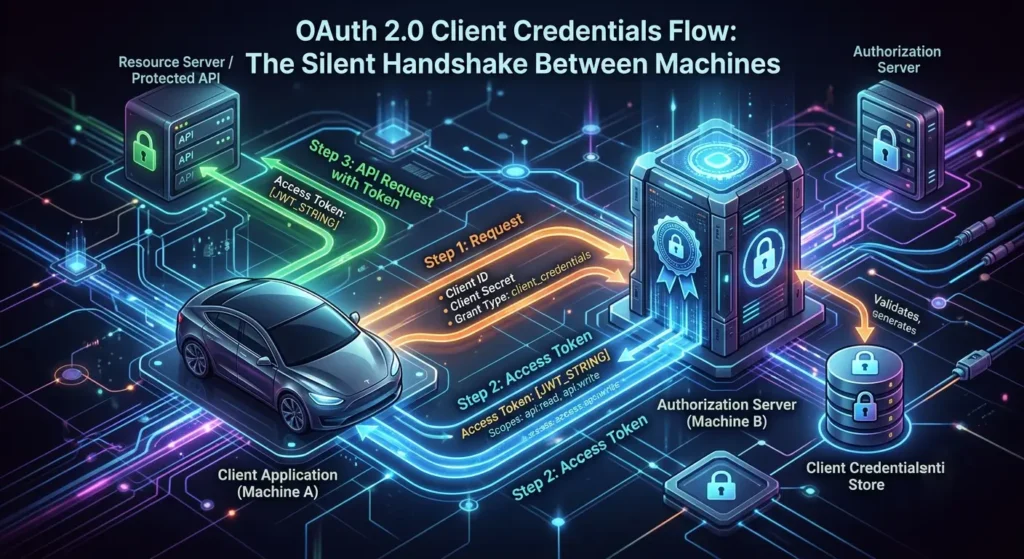
This is where the metaphor sharpens: think of the client credentials flow as a passport issued not to a traveler, but to a courier vehicle. The vehicle doesn’t need a personal identity it needs a documented, verifiable right to cross borders on behalf of its cargo. The client ID and client secret function exactly like this passport, presented at a checkpoint (the authorization server) in exchange for a temporary visa (the access token) that allows entry into a specific territory (the protected API).
Behind the Curtain: How the Flow Actually Works
Picture a nightclub with a strict bouncer. The client application walks up not a person, but a script or service and quietly murmurs its credentials into the bouncer’s ear. The bouncer, who is really the authorization server, verifies the credentials against a private ledger. If everything checks out, the bouncer hands over a wristband: the access token. This wristband is time-limited, non-transferable, and only grants access to specific rooms the scopes inside the club.
Armed with this wristband, the client walks confidently into the resource server, flashes the token, and gets what it came for: data, permissions, or the ability to trigger an action. No names are exchanged beyond the initial credentials. No user session lingers. Once the wristband expires, the client must return to the bouncer and repeat the ritual.
This elegant simplicity is precisely why the flow is favored for trusted backend systems CI/CD pipelines fetching secrets, billing systems reconciling ledgers, or internal APIs orchestrating workflows across cloud environments.
The Craft of Secure Implementation
Vivid as the metaphor is, real implementations demand rigor. Secrets must be rotated like keys changed after a lease ends. Tokens must be short-lived, scoped narrowly, and transmitted only over encrypted channels. Developers learning these patterns often during a full stack development course quickly discover that authentication isn’t a checkbox; it’s an ongoing discipline requiring careful architecture decisions, from token storage to revocation strategies.
Poorly managed client secrets are the equivalent of a factory leaving its stamped seal lying on the loading dock unattended. Anyone who finds it can forge identity, walk through the gates, and access sensitive systems undetected. This is why credential vaults, secret managers, and automated rotation policies aren’t optional extras they’re the locks on the factory gate.
Where the Metaphor Meets Modern Architecture
As microservices multiply and cloud-native systems become the norm, the “factory-to-factory” trust model scales beautifully. Each service, however small, can carry its own passport, request its own visa, and interact autonomously with other services all without a human ever being in the loop. This is precisely why platforms teaching distributed systems architecture, including a well-structured full stack development course, emphasize the Client Credentials Flow as foundational knowledge for anyone building modern backend ecosystems.
Conclusion: The Quiet Backbone of Machine Trust
Beneath the surface of nearly every modern digital service lies this quiet, tireless choreography machines proving themselves to machines, exchanging temporary passes, and moving data without fanfare or human oversight. The OAuth 2.0 Client Credentials Flow isn’t glamorous, but like the loading docks and passport checkpoints it resembles, it keeps the invisible infrastructure of the internet running smoothly, securely, and silently one verified handshake at a time.
Business Name: ExcelR – Full Stack Developer And Business Analyst Course in Bangalore
Address: 10, 3rd floor, Safeway Plaza, 27th Main Rd, Old Madiwala, Jay Bheema Nagar, 1st Stage, BTM 1st Stage, Bengaluru, Karnataka 560068
Phone: 7353006061
Business Email: enquiry@excelr.com