Introduction
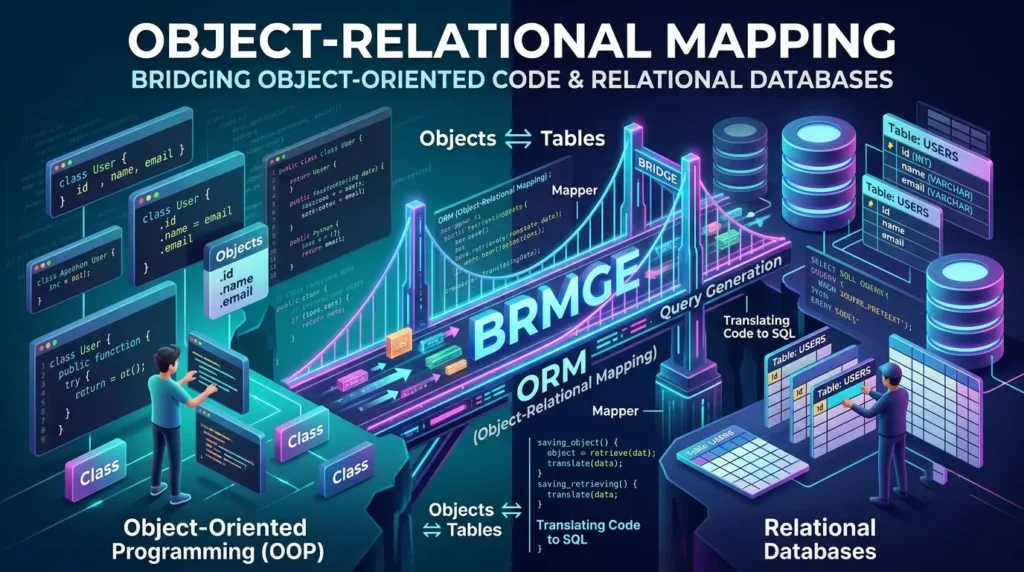
Most modern applications are written using object-oriented programming (OOP), where data is represented as objects with properties and methods. At the same time, many production systems rely on relational databases, where data is stored in tables with rows and columns. These two worlds do not naturally align. Object-Relational Mapping (ORM) solves this mismatch by providing a structured way to convert data between incompatible type systems—objects in code and records in a relational database.
An ORM goes beyond being merely a convenience feature; when it is used properly, it enhances developer productivity, ensures consistency when accessing the database, and decreases the amount of repetitive SQL code that is dispersed throughout an application. If you are studying backend development as part of a full stack developer course, a understanding of ORMs will enable you to write cleaner data access logic and help you avoid the common pitfalls found in database-driven applications.
Why ORM Exists: The Object–Relational “Impedance Mismatch”
Information in relational databases is presented in a tabular format, while object-oriented applications represent it as a series of nested objects and the relationships between those objects. This discrepancy is evident in a number of ways.
- Tables have a flat structure, while objects can be nested and combined.
- With regard to identity rules, databases make use of primary keys while objects use references in memory.
- In the case of different relationship models, databases make use of foreign keys and joins, while objects employ direct links (for example, user.orders).
- Various type systems: databases have types such as VARCHAR, INT, and DATE; whereas application languages use strings, integers, and date-time classes which behave differently.
ORM frameworks assign classes to tables and object fields to columns; they also look after relationships (such as one-to-one, one-to-many, and many-to-many) so that developers can work using familiar object structures while the ORM produces the SQL required for reading and writing data.
How ORM Works in Practice
An ORM generally lies between the application code and the database driver and its main duties consist of mapping, querying and transaction handling.
Mapping objects to tables
You create a class which represents a database table, the ORM using configuration or annotations to map the fields:
- Class → table
- Field/property → column
- Object relationship → foreign key relation
For instance, a Customer class could be associated with a customers table, and a Customer object would have properties such as id, name, and email, these corresponding to the columns.
Querying through objects
Instead of writing raw SQL for every operation, you use ORM query methods such as:
- Find by ID
- Filter by column values
- Join related entities through relationships
- Paginate results
Although most object-relational mapping tools do allow the use of raw SQL when necessary, their primary advantage lies in providing consistent querying and cutting down on the amount of boilerplate code.
Managing transactions and persistence
ORM tools also assist with the management of database transactions so that you can group a number of operations together and make sure that they all succeed or all fail; this is important for maintaining data integrity, particularly in systems which deal with payments, inventory, or order workflows.
The specific skills in question become practical when working on systems that have a lot of CRUD operations in a full stack course, as database interactions are common in such situations.
Key Benefits of Using an ORM
ORMs are popular because they solve common development pain points:
Faster development and maintainability
ORM eliminates repetitive SQL statements and makes data access more consistent; rather than manually mapping the results of a query into objects, you are given the domain objects directly.
Better readability and structure
The code is easier to follow when the business logic is used with objects such as Invoice, Product, or Student rather than having a large number of scattered query strings throughout various layers.
Safer parameter handling
Most query builders available through ORM systems automatically include parameters, which reduces the risk of SQL injection when compared with the use of unsafe string concatenation.
Database portability (to an extent)
ORMs generally abstract the differences between database engines, so that although some advanced features will still be specific to the database, the basic operations can remain the same on all systems.
When you are taking a full stack developer course and learning production-style backend design, an ORM is one of the quickest methods of creating stable data access layers without sacrificing structure.
Common ORM Pitfalls and How to Avoid Them
Although ORM is useful, it isn’t free since misuse can lead to performance problems and behaviour that is difficult to debug.
The N+1 query problem
This happens when an application first loads a list of parent objects and then loads the related data individually using separate queries. It is capable of silently increasing the number of database calls to dozens or even hundreds.
Way to avoid this: when retrieving related data, use eager loading or include the records explicitly with joins.
Over-fetching and inefficient queries
You might end up getting more data than you actually need if your ORM is set to load large object graphs by default, and this can cause the application to run more slowly.
The way to avoid this is to check only the fields that are needed, use pagination, and make sure the query performs well.
Hidden complexity
ORMs can conceal the SQL so effectively that developers end up forgetting what the database is really doing, which in turn can cause slow queries, the omission of indexes, or a poorly designed schema.
How to avoid this: keep an eye on the SQL that is generated, use query logs, and make sure you understand indexing and execution plans.
Schema drift and migration issues
It is essential that your classes and database schema remain in line; otherwise you’ll experience runtime failures.
Avoid it by using migration tools and making schema reviews part of your deployment process.
It is worthwhile learning about these problems early on in a full stack course since they tend to show up as an application expands past the stage of a demo project.
Conclusion
Object-Relational Mapping is a practical method of converting data between object-oriented code and relational database systems; it enables developers to use objects which they are used to while at the same time making use of the reliability and structure of relational tables. So long as it is used correctly, an ORM increases the speed of development, ensures that data access remains consistent, and promotes safer querying practices.
At the same time, ORM must be used carefully if you are to avoid pitfalls such as N+1 queries and over-fetching. By having a good understanding of the processes involved in mapping and query generation, you will be able to use ORM to create applications that are both maintainable and efficient—skills which are directly relevant to a full stack developer course as well as to any actual backend project.
For more details visit us:
Name: ExcelR – Full Stack Developer Course in Hyderabad
Address: 49, 2, Unispace Building, 4th-floor, Plot No.47 48, Street No. 1, Patrika Nagar, Madhapur, Hyderabad, Telangana 500081
Phone: 08792483183
Email: enquiry@excelr.com