I need to tell you about the worst $500 I ever spent.
It was 2022, and I’d just launched a side hustle selling handmade candles. I was convinced that all I needed was more followers, so I threw $500 at Instagram ads without really knowing what I was doing. The result? I gained 2,000 followers in a week. I felt like a genius.
Then… nothing. These new followers didn’t engage with my posts. They didn’t buy anything. They didn’t even like my content. Turns out, most of them were bots or people from random countries who had zero interest in candles. I’d basically set $500 on fire, which is ironic considering my product.
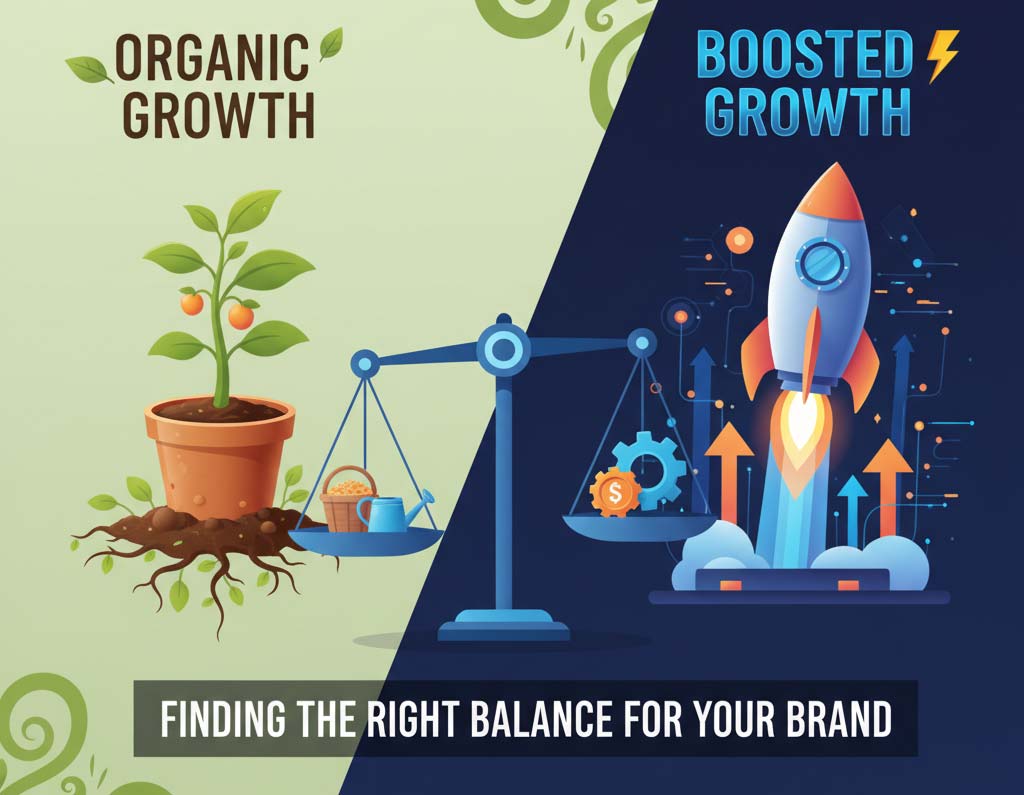
That failure taught me something valuable though: growth without strategy is just vanity. And the organic versus paid growth debate? It’s not actually a debate at all. It’s about finding the right mix for YOUR specific situation.
Let me walk you through what I’ve learned since then, both from my own mistakes and from watching dozens of other businesses figure this out.
What Organic Growth Actually Means (And Why It’s Harder Than You Think)
Organic growth is basically building your audience the old-fashioned way—posting content, engaging with people, hoping the algorithm gods smile upon you. No paid ads. No boosted posts. Just you, your content, and a whole lot of patience.
Sounds simple, right? It’s not.
I spent six months posting consistently on Instagram—three times a week, carefully curated photos, thoughtful captions, relevant hashtags. My follower count? Grew from 120 to 180. That’s 60 followers in six months. I could’ve met more people by just standing on a street corner with a sign.
But here’s what those numbers don’t show: those 60 followers were real people who actually cared. They commented on posts. They shared my content. Three of them became paying customers. And one of them referred five other customers. So that “slow” growth? Actually generated real revenue.
Organic growth feels like pushing a boulder uphill. It’s exhausting. Progress is slow. But when it works, the audience you build is solid.
The Truth About Paid Growth (It’s Not Evil, But It’s Not Magic Either)
After my candle business disaster, I avoided paid growth for a year. I was burned (pun intended). But then I watched my friend Sarah launch her coaching business, and she did something smart.
Instead of boosting random posts hoping for followers, she created a really specific ad targeting women in their 30s interested in career transitions, living within 50 miles of her city. She spent $200 over two weeks. She gained 150 followers, but more importantly, she got 12 new clients worth $6,000.
That’s the difference. She didn’t pay for vanity metrics. She paid to put her content in front of the exact people who needed it.
Paid growth isn’t inherently bad. It’s a tool. Like any tool, you can use it brilliantly or you can whack yourself in the face with it. I did the face-whacking. Sarah used it brilliantly.
The Hybrid Approach (Where the Real Magic Happens)
Here’s what nobody tells you when you’re starting out: the best strategy uses both. But not randomly. Strategically.
Think of organic growth as building your foundation. It’s creating content that resonates, engaging authentically, developing your voice, understanding what your audience actually wants. This is slow but crucial.
Then paid growth amplifies what’s already working. You don’t pay to figure out your message—you pay to spread a message you’ve already proven works.
My current approach with my business (I eventually sold the candles and moved into consulting) looks like this: I post organic content five times a week. I engage genuinely with my audience. I track what performs well. Then, when I create something that really hits—a post that gets 3x my normal engagement—I boost that post to reach more people like my existing engaged followers.
This way, I’m not gambling. I’m amplifying proven winners.
When Organic Growth Makes the Most Sense
When you’re just starting out. You need to understand your audience first. What do they respond to? What problems do they have? You can’t shortcut this learning curve with money.
When you’re building authority. People can smell paid growth a mile away. If you have 10K followers but only 20 likes per post, everyone knows. Authority comes from genuine engagement.
When you’re in a niche market. My buddy runs a beekeeping equipment business. His market is maybe 5,000 people regionally. Organic growth through beekeeping forums made way more sense than paid ads.
When your margins are tight. Bootstrapping and every dollar counts? Organic might be your only option. I spent months in Facebook groups, answering questions, providing value without selling. Eventually, people checked out my profile and some became customers.
When Paid Growth Makes Sense
When you’ve proven product-market fit. You know people want what you’re offering. You’ve got testimonials. Now you need more eyeballs.
For time-sensitive campaigns. Launching something or running a sale? Organic won’t move fast enough. Strategic paid push gets eyes on your offer quickly.
When you need to test markets quickly. Wondering if your product appeals to retirees or millennials? Small budget split between targeted ads tells you in a week what might take months organically.
When the ROI clearly justifies it. If you spend $100 on ads and make $500, that’s obvious. Keep doing it. Spend $100 and make $50? Stop and figure out what’s wrong.
I run a simple test before any paid campaign: Can I clearly articulate who I’m targeting, what action I want them to take, and how I’ll measure success? If I can’t answer all three, I don’t spend the money.
The Mistakes I See Everyone Make
Mistake #1: Buying followers directly. Those “1,000 followers for $10” services sell fake accounts. They’ll never engage or buy. Your engagement rate tanks, hurting organic reach. It’s a death spiral.
Mistake #2: Boosting without a strategy. Clicking “Boost Post” because Instagram suggests it isn’t strategy. Before you boost: What’s my goal? Who am I targeting? What action do I want?
Mistake #3: Neglecting organic while paying. Spending thousands on ads driving traffic to a dead profile that hasn’t posted in weeks. Your organic presence must be solid first.
Mistake #4: Not tracking ROI. Use UTM codes. Use unique discount codes. Track everything. Your feelings don’t matter. Numbers do.
Mistake #5: Giving up on organic too soon. Three months feels like forever, but algorithms take time. Most people quit right before things would’ve worked.
Building Your Balanced Strategy
Start with 90/10: Organic/Paid
When beginning, spend 90% effort on organic growth. Create great content. Engage genuinely. Learn what works. Spend 10% experimenting with small paid campaigns.
Start with just $50-100 for testing. Pick your best organic post and boost it to a targeted audience. See what happens. Learn. Adjust.
Track Everything
You need to know:
- Cost per follower
- Engagement rate
- Click-through rate
- Conversion rate
- Customer acquisition cost
Scale What Works, Kill What Doesn’t
Track your content performance religiously. Educational posts consistently outperform promotional ones for me, so I create more and occasionally boost the best. Behind-the-scenes posts get decent engagement but don’t convert to sales, so I keep them organic.
Adjust Your Mix as You Grow
When small, you’ve got more time than money. As you grow and generate revenue, shift to maybe 70/30 or 50/50 if paid channels generate strong ROI. There’s no universal answer.
The Role of Content Quality in Both
Here’s the thing: you need good content regardless of strategy. Paid growth won’t save bad content.
I boosted a mediocre post with a decent budget. It reached 50,000 people. Got maybe 100 profile visits and zero sales. Why? Content wasn’t good enough.
Then I created something genuinely valuable—a free checklist my audience needed. Posted it organically, it performed well, so I boosted it with a tiny budget. Converted like crazy because the content was actually good.
Content quality is the foundation. Everything else builds on top of it.
Real Talk: The Algorithm Isn’t Your Enemy
I used to think Instagram’s algorithm was conspiring against me. Then I realized: the algorithm wants to show my content to people who’ll engage with it because engaged users spend more time on the platform. We’re aligned.
The problem wasn’t the algorithm. It was that my content wasn’t engaging enough. Once I focused on creating content people actually wanted, my organic reach improved dramatically. Stop fighting the algorithm. Work with it.
When to Consider Services for Growth
Look, I’m going to be honest about something controversial: there are legitimate services that can help accelerate your growth in authentic ways.
I’m not talking about buying fake followers. I’m talking about strategic social media growth services that help you reach real, targeted audiences who might actually be interested in what you offer.
The key is understanding what you’re getting. Legitimate services focus on targeted growth—putting your content in front of people who match your ideal customer profile. This is different from bulk followers from click farms.
Think of it like the difference between handing out flyers at a random mall versus presenting at a conference where everyone in attendance is specifically interested in your industry. Both cost money, but one is strategic.
Do your homework. Ask questions. Understand exactly what you’re paying for. If something sounds too good to be true (5,000 followers for $20!), it absolutely is.
Measuring Success Beyond Follower Count
Follower count is one of the least important metrics.
I know an account with 50K followers that makes $1,000/month. Another with 5K followers makes $10,000/month. Which is more successful?
Metrics that actually matter:
- Engagement rate: (Likes + Comments + Shares) ÷ Followers
- Conversion rate: What percentage actually buys?
- Customer lifetime value: How much is each customer worth over time?
- Return on investment: For every dollar spent, what do you get back?
A highly engaged 1,000 real people beats a disengaged 10,000 every time.
My Current Approach (After All These Lessons)
After years of trial and error, here’s what my strategy looks like now:
Monday through Thursday: Organic content. I post valuable content, engage with my audience, respond to comments and DMs, participate in relevant conversations. This is my foundation.
Friday: Analytics review. I look at what performed well this week. What got high engagement? What drove profile visits? What led to DM conversations?
Once or twice a month: Paid boost. I take my best-performing content and boost it to a targeted audience with a small budget ($50-100). I track the results carefully.
Quarterly: Big paid campaign. Every few months, I invest more significantly in a paid campaign for a specific launch or promotion. But only after I’ve proven the offer works organically first.
This approach keeps my organic presence strong while strategically using paid growth to amplify what’s already working.
The Bottom Line
Here’s what I wish someone had told me when I wasted that $500 on Instagram ads:
Neither organic nor paid growth is inherently better. They’re tools that serve different purposes at different stages.
Organic growth builds authentic, engaged audiences but takes time. Paid growth accelerates reach but requires budget and strategy. The magic happens when you use both intelligently.
Start organic. Learn your audience. Create content that resonates. Then use paid growth to amplify what’s already working. Track everything. Adjust based on results, not feelings.
And please, for the love of everything, don’t buy followers from sketchy websites. I’ve seen too many businesses damage their credibility and tank their engagement rates chasing vanity metrics.
Build something real. Even if it’s slower than you want. Because a small, engaged audience that actually cares beats a massive, fake audience that doesn’t give a damn about you.
Growth for growth’s sake is meaningless. Growth that drives real business results? That’s what we’re after.
Your Next Steps
If you’re sitting here wondering where to start, here’s my advice:
Spend the next 30 days focused purely on organic growth. Post consistently. Engage genuinely. See what resonates with your audience. Don’t spend a penny on promotion yet.
After 30 days, review your best-performing content. Pick the top performer and boost it with a small budget ($50) to a highly targeted audience. Track the results obsessively.
Based on what you learn, adjust your strategy. Maybe you discover organic is working great and you’ll stick with it. Maybe you find paid amplification of proven content drives amazing ROI. Maybe you realize you need to improve your content before either strategy works.
The point is: test, measure, learn, adjust. That’s how you find the right balance for YOUR brand, not some theoretical ideal that may or may not apply to your situation.
Ready to Grow Your Brand Strategically?
At GTR Socials, we help brands find the right balance between organic and strategic growth. Whether you’re looking to build an authentic audience or amplify your reach to the right people, we provide solutions tailored to your specific goals and budget.
Want to explore how strategic growth can complement your organic efforts? Check out our flexible pricing options designed for businesses at every stage.
Visit gtrsocials.com to learn more about building sustainable social media growth that actually drives business results.