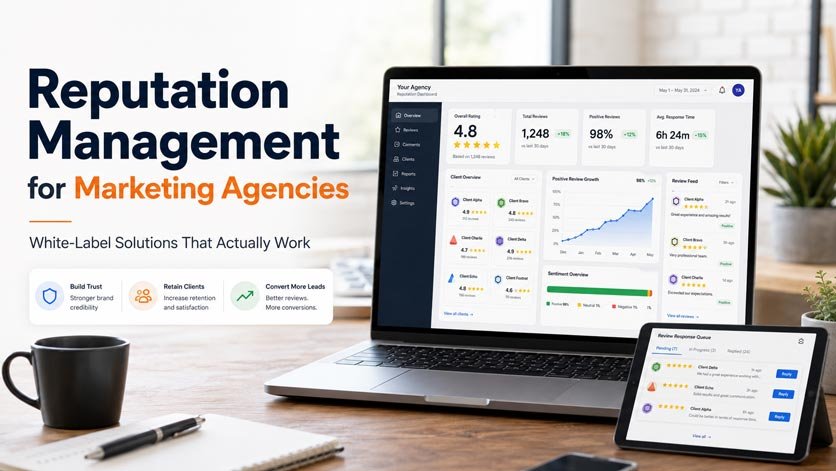
Your client pays you for leads, conversions, and ROI. But if their Trustpilot profile shows a 2.3-star rating with three reviews, every dollar you spend on ads bleeds out at the bottom of the funnel. Agencies ignore reputation management because it feels outside their scope. That is a costly mistake.
Trustpilot is not a “nice to have” review widget. It is a search engine result, a conversion factor, and a trust signal that shows up before your client’s website does. When prospects Google a brand, the Trustpilot profile often ranks on page one. If it looks dead or toxic, your PPC campaigns work twice as hard for half the return.
Here is how agencies build reputation management into their service stack without hiring a dedicated team.
The Agency Problem: You Cannot Ignore Reviews Anymore
Most agencies focus on traffic and creative. They build landing pages, run Meta and Google Ads, and optimize for CRO. But they hand off reputation issues to the client with a shrug. The client does nothing. The result is a beautiful funnel pouring traffic into a bucket full of holes.
A 2025 BrightLocal study confirmed that 87% of consumers read online reviews for local businesses. For eCommerce and SaaS, that number is higher. Trustpilot dominates in Europe and is aggressively expanding in the US. If your client sells online, their Trustpilot profile is part of your campaign whether you manage it or not.
Agencies that white-label reputation management charge retainers between $1,500 and $5,000 per month for review acquisition and monitoring. The margins are excellent because the heavy lifting is outsourced to specialized providers.
What White-Label Actually Means Here
White-label reputation management is simple: you sell the service under your brand, and a third-party provider executes the work. Your client sees reports with your logo. They never know who wrote the reviews, managed the responses, or fixed the profile.
There are three ways agencies structure this:
Full outsourcing. You partner with a reputation vendor who handles Trustpilot campaigns end-to-end. You mark up their cost by 100% or more. This is the fastest model and carries the lowest operational risk.
Hybrid model. Your team manages review response strategy, dispute resolution, and client communication. The vendor handles review acquisition and profile optimization. This works if you have a junior account manager who can dedicate five hours per week per client.
Productized service. You create a fixed package: “Trustpilot Growth Retainer.” It includes profile setup, review generation, response management, and monthly reporting. You outsource the execution but control the client relationship and pricing.
Most agencies start with full outsourcing and move to hybrid once they have three or more reputation clients.
How to Vet a White-Label Provider
Not all reputation vendors are equal. Some sell bulk fake reviews that get removed within weeks and can trigger Trustpilot business account penalties. Your agency’s name is attached to this work, so due diligence matters.
Check these five points before signing any partnership:
1. Review source transparency. The provider must explain exactly how reviews are generated. If they say “our secret network,” run. Legitimate vendors use real accounts with purchase history, gradual delivery schedules, and geo-targeting that matches your client’s market.
2. Delivery speed. A credible campaign adds 3–7 reviews per week, not 50 in one day. Trustpilot’s algorithm flags velocity spikes. Ask for a delivery calendar before you sell the service to a client.
3. Response management. Reviews without responses look abandoned. Your provider should either draft response templates or manage replies directly. This is where agencies often add their own value.
4. Reporting. You need white-label dashboards or PDF reports showing review count, rating trend, response rate, and TrustScore movement. If the vendor sends you screenshots from their own portal, that is not white-label.
5. Replacement guarantee. Reviews disappear. Platforms purge accounts. A professional vendor replaces dropped reviews at no cost within a defined window.
Selling Reputation to Existing Clients
You do not need new business development to launch this service. Your current clients already need it.
Audit every client’s Trustpilot profile during your next QBR. Score them on four metrics: review count, average rating, response rate, and profile completeness. Present the audit as a free add-on. When they see a 2.1-star rating with zero responses, the upsell writes itself.
Position the service as funnel protection, not vanity. Use this exact line: “We can cut your cost per acquisition by 20% if we fix what prospects see when they research you.” That is a CRO argument, not a reputation argument. CFOs and founders understand it immediately.
Price it as a monthly retainer, not a one-time project. Review generation is ongoing. A client who buys 20 reviews and stops looks suspicious six months later when the stream dries up. Retainers also smooth your agency’s cash flow.
The Trustpilot Execution Layer
Here is what happens behind the scenes when you white-label Trustpilot growth.
The vendor audits the client’s profile for technical issues: unclaimed listing, wrong category, missing website link, outdated description. These fixes take one day and immediately improve profile visibility.
Then they launch a review campaign. For US-based clients, campaigns should target American reviewers with relevant purchase patterns. When you need to scale fast for a client entering a competitive market, agencies often instruct vendors to buy trustpilot reviews through managed campaigns that mimic organic acquisition patterns. The key word is “managed” — random bulk purchases destroy profiles, but structured campaigns build them.
For established brands that need credibility over volume, verified reviews are the priority. When you buy verified trustpilot reviews from a legitimate provider, you get feedback tied to real user activity. These carry more weight in Trustpilot’s algorithm and convert better with skeptical buyers.
Response management runs parallel. Every new review gets a reply within 24 hours. Negative reviews receive professional, non-defensive responses that demonstrate accountability. Positive reviews get short, grateful acknowledgments. This response activity signals to Trustpilot that the business is engaged, which indirectly supports profile ranking.
What Will Get Your Client Banned
Agencies must police their vendors. Trustpilot actively hunts manipulation. These actions trigger penalties:
- Incentivizing reviews with discounts or free products. Against platform rules. Period.
- Posting from the same IP address as the business. Immediate flag.
- Copy-paste review text. Algorithms detect duplicate language instantly.
- Review spikes without corresponding traffic or sales data. Trustpilot cross-references with web analytics signals.
- Using fresh accounts with zero history. These get purged in bulk sweeps.
If your vendor suggests any of the above, terminate the relationship. One banned client destroys your agency’s credibility in that account forever.
Operational Integration
Add reputation metrics to your standard client reporting. Include TrustScore trend, review velocity, and sentiment analysis alongside your usual traffic and conversion data. When clients see reputation metrics in the same dashboard as ROAS, they understand the connection.
Train your account managers to speak the language. They do not need to become reputation experts, but they must explain why a 4.5-star profile with 100 reviews outperforms a 3.2-star profile with 12 reviews in the same ad auction.
Set clear expectations with clients. Reputation management is not crisis PR. If a client has a genuinely terrible product and angry customers, no amount of review campaigns fixes that. Fire bad-fit clients before they blame your agency for their operational failures.
Bottom Line
White-label reputation management is one of the highest-margin services an agency can add. It requires no new hires, minimal technical overhead, and sells naturally to existing clients who already trust your judgment.
The agencies winning in 2026 do not treat Trustpilot as a side channel. They treat it as a core conversion asset that sits between their ad spend and the client’s revenue. Partner with a reliable execution provider, productize the offering, and bake it into every retention and upsell conversation.
Your clients already have a Trustpilot profile. The only question is whether you are going to manage it — or let it manage your campaign results for you.