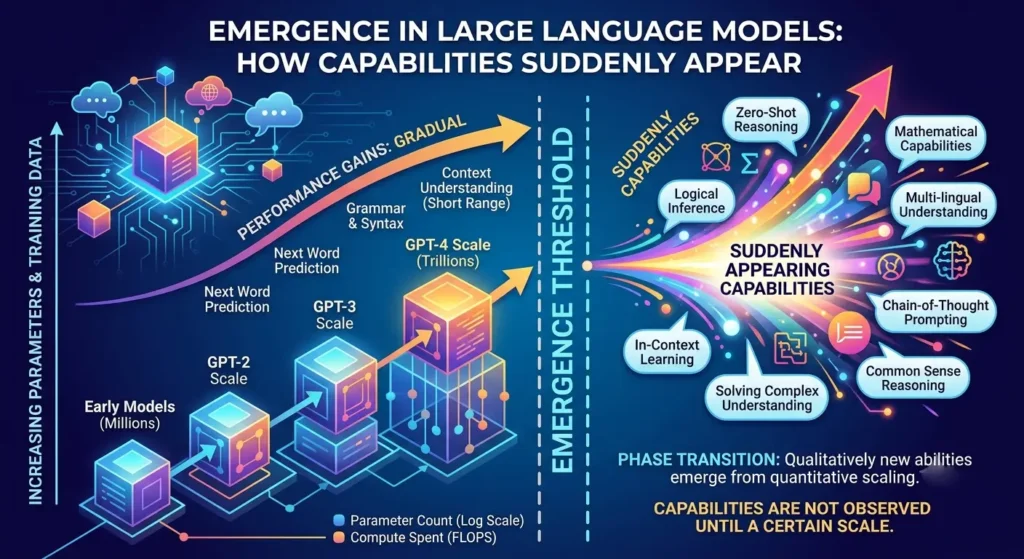
Large language models (LLMs) have surprised researchers and practitioners by showing skills that were not explicitly programmed, such as following multi-step instructions, solving unfamiliar reasoning tasks, or translating between languages with limited examples. These “sudden” jumps in ability are often described as emergence. The idea is simple to state but nuanced to understand: as models grow in size, data, and training time, new capabilities can appear quickly over a narrow range of scale, even when earlier versions showed little or no sign of the same behaviour. For learners in an artificial intelligence course, emergence is an important topic because it shapes how we evaluate, deploy, and govern modern AI systems.
What Do We Mean by Emergence?
In the context of LLMs, emergence refers to behaviours that seem to appear abruptly once a model crosses a certain threshold of scale or training. A smaller model may perform close to random on a task, while a larger model performs surprisingly well. Examples often include arithmetic reasoning, step-by-step instruction following, code generation, or handling complex question formats.
However, “suddenly appear” can be misleading. Many researchers argue that emergence is partly an artefact of how we measure performance. If we use a strict metric (for example, exact-match accuracy), gradual improvement can look like a sudden jump once the model starts getting enough answers exactly right. This means emergence can reflect both genuine capability changes and the shape of the evaluation curve.
For students taking an ai course in bangalore, the key learning is to treat emergence as a phenomenon to be tested carefully, not as a magical property of scale.
Why Capabilities Can Look Like They Appear Overnight
Several mechanisms can make model improvements look discontinuous even if underlying learning is more continuous.
1) Threshold effects in evaluation
Some tasks have “all-or-nothing” scoring. For example, in multi-step reasoning, one mistake leads to a wrong final answer. A model might improve its internal reasoning gradually, but accuracy stays low until it becomes reliable across most steps. Once it crosses that reliability threshold, accuracy rises sharply.
2) Composition of skills
Many LLM tasks are composites: reading comprehension + logic + basic maths + following instructions. A smaller model might be weak in one component, limiting overall performance. When scaling improves the weakest link, the combined task performance can jump.
3) Rare pattern coverage
Some behaviours require exposure to specific patterns in training data. Larger models trained on more data may encounter enough examples to generalise. This can make a capability appear suddenly if earlier models simply did not have sufficient exposure or capacity to store and generalise those patterns.
4) Representation and capacity changes
As models scale, they can form richer internal representations. This allows them to store more “latent programs” — patterns of computation that can be reused across tasks. Once those representations become stable, the model may generalise in ways that were previously impossible.
What Scaling Really Changes: Data, Compute, and Training Dynamics
Emergence is often tied to scaling laws: empirical observations that performance improves predictably with more parameters, more data, and more compute. But the practical story is more complex.
- More parameters increase the capacity to represent knowledge and patterns.
- More data expands coverage of language, reasoning structures, and domains.
- More compute allows longer training and better optimisation.
Yet, bigger is not always better in a straightforward way. Training quality, data mixture, tokenisation, and optimisation choices can change which capabilities appear and when. Two models with similar parameter counts can behave differently based on data curation and alignment methods.
From an engineering perspective, this matters because you cannot assume that scaling alone guarantees a capability. In an artificial intelligence course in bangalore, this is often framed as “architecture and training choices are part of the product,” not just parameter count.
Emergence vs. Illusion: Why Measurement Matters
A major debate is whether some emergent abilities are truly new or simply become visible due to metric choice. Consider two ways of measuring:
- Exact accuracy: looks sudden when the model starts meeting strict criteria.
- Probabilistic scoring (e.g., log-likelihood or partial credit): often shows smoother progress.
This is why robust evaluation matters. If you only track one metric, you might overestimate the “shock” of emergence and underestimate the gradual learning that preceded it. Better evaluation includes:
- multiple metrics (accuracy + calibration + partial credit),
- stress tests (adversarial prompts, out-of-distribution data),
- and behavioural checks (consistency, refusal behaviour, and hallucination rates).
Learners in an ai course in bangalore benefit from this approach because it prepares them to assess real model readiness rather than relying on headline claims.
Why Emergence Matters for Real-World Deployment
Emergence is not just an academic curiosity. It has practical implications:
- Unpredictability: a capability can appear at scale without being anticipated, which can introduce both opportunities and risks.
- Safety and governance: new behaviours may include unsafe ones, like better persuasion or more convincing misinformation generation.
- Product reliability: a model might perform well in demos but fail under edge cases if the “emergent” skill is brittle.
- Continuous evaluation: teams must monitor model behaviour after updates, since capabilities can shift with retraining or fine-tuning.
In production, the right mindset is to treat LLMs as evolving systems that require monitoring, benchmarking, and guardrails.
Conclusion
Emergence in large language models describes how new capabilities can appear quickly as scale increases, but the phenomenon is shaped by both real learning dynamics and the way we measure performance. Threshold effects, composite skills, data coverage, and representational capacity can all contribute to sudden-looking jumps. For practitioners and learners, the key takeaway is to evaluate carefully and design responsibly, because emergent behaviour can be powerful but also unpredictable. If you are studying this area through an artificial intelligence course in bangalore or building hands-on understanding via an ai course in bangalore, focusing on rigorous evaluation and practical deployment concerns will help you translate the concept of emergence into real-world engineering judgement.
For more details visit us:
Name: ExcelR – Data Science, Generative AI, Artificial Intelligence Course in Bangalore
Address: Unit No. T-2 4th Floor, Raja Ikon Sy, No.89/1 Munnekolala, Village, Marathahalli – Sarjapur Outer Ring Rd, above Yes Bank, Marathahalli, Bengaluru, Karnataka 560037
Phone: 087929 28623
Email: enquiry@excelr.com