Introduction: The Air Traffic Controller of Your Digital Ecosystem
Imagine a massive international airport where dozens of aircraft — each carrying a different airline’s passengers — must land, depart, and communicate seamlessly without chaos. Now picture your website. Every click, scroll, form submission, and video play is a flight waiting to be directed. Without a control tower, planes collide. Without tag management, your data does too.
That is exactly what Google Tag Manager (GTM) and similar platforms represent: a digital air traffic controller, coordinating the constant flow of behavioral signals between your website and analytics destinations. For anyone pursuing a data analytics course today, understanding tag management is no longer optional — it is foundational.
What Tag Management Actually Does (And Why Raw Code Fails)
Before tag managers existed, marketing and analytics teams had to beg developers for every pixel placement. Want to add a Facebook conversion tag? File a ticket. Need to modify a Google Ads remarketing snippet? Wait two weeks. This bottleneck cost companies millions in delayed insights.
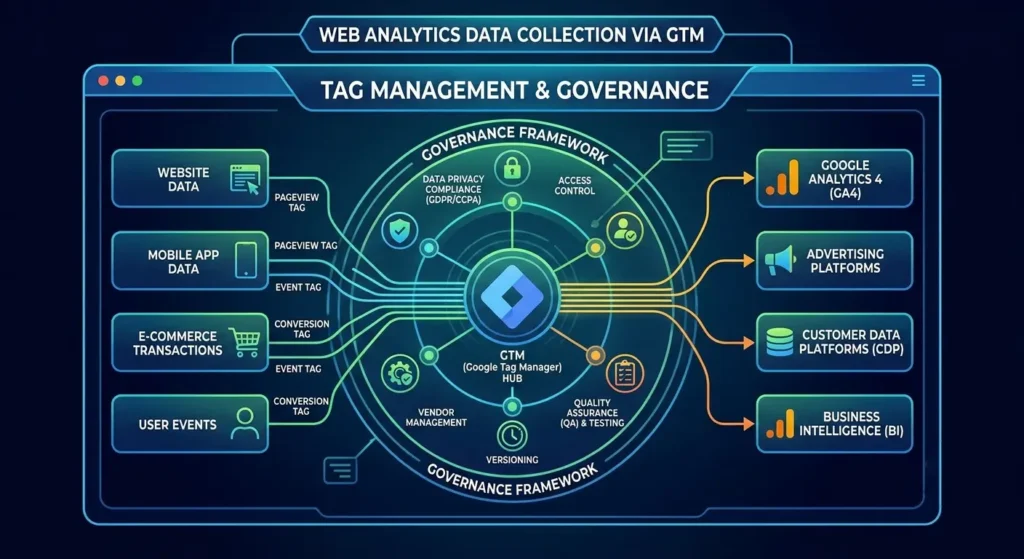
GTM changed that by decoupling tags from the underlying codebase. A single container snippet lives on your site, and from there, marketers can deploy, modify, and retire tags through a browser-based interface — no direct code deployment required. Tealium, Adobe Launch, and Segment offer similar architectures, each with enterprise-grade governance layers.
The power lies in the trigger-variable-tag trinity: triggers define when something fires, variables capture what data is collected, and tags determine where that data goes. Miss any leg of this triangle, and your analytics house collapses.
Implementation: Building a Governance-First Architecture
Here is where most teams go wrong — they treat GTM as a dumping ground rather than a governed system. Tags accumulate like unpaid invoices: old, forgotten, and quietly draining performance.
A governance-first approach begins before a single tag is deployed. Define a data layer schema upfront. The data layer — a JavaScript object sitting between your site and GTM — is the single source of truth for all structured data. Event names, parameter conventions, and data types must be agreed upon, documented, and enforced through naming conventions such as category_action_label.
Workspace management matters equally. GTM’s built-in version control allows teams to work in isolated environments, review changes before publishing, and roll back instantly when something breaks. Combine this with a change log protocol — who changed what, when, and why — and you transform a wild west of tags into an auditable, trustworthy infrastructure.
For professionals enrolled in a data analyst course in Pune or any metro hub, mastering this governance layer is what separates junior analysts from those who design enterprise-grade measurement frameworks.
Tracking Events That Actually Move Decisions
Not every click deserves a tag. This is the analytical paradox most teams never resolve: they instrument everything and understand nothing.
Effective event tracking starts with a measurement plan — a living document that maps business questions to specific user interactions. Which page scroll depth predicts purchase intent? Does a chatbot initiation correlate with reduced bounce? Does video completion on a course page predict enrollment?
GTM’s event-driven model allows Custom HTML tags, GA4 event tags, and third-party pixels to fire based on precisely defined conditions. Enhanced Measurement in GA4 automates scroll tracking, outbound clicks, and file downloads — but custom events capturing micro-conversions remain hand-crafted. Variables like {{Click URL}}, {{Form ID}}, and {{Page Path}} become the vocabulary of precision measurement.
The real magic happens when tag data feeds into BigQuery or Looker Studio dashboards, converting raw behavioral streams into the kind of decision intelligence that changes roadmaps.
Governing Privacy, Consent, and Data Quality
Tag management without consent management is a liability waiting to materialize. GDPR, India’s DPDP Act, and evolving global frameworks demand that no analytics or advertising tag fires before a user grants explicit consent.
GTM integrates with Consent Mode v2, allowing tags to operate in “cookieless” mode when consent is denied — preserving modeling capability without violating user rights. Consent state variables (ad_storage, analytics_storage) become the gatekeepers every tag must pass through.
Data quality governance — regular tag audits, dead tag removal, and trigger validation — is where ongoing discipline pays dividends. Tools like Tag Assistant, ObservePoint, and Adswerve’s dataLayer Inspector transform auditing from guesswork into systematic verification. For someone building career depth through a data analytics course, this operational rigor is what creates long-term analytical credibility.
Conclusion: The System Behind the Insight
Tag management is not a technical chore to hand off and forget. It is the architecture of your analytical truth. GTM and its peers give organizations the power to move fast on measurement — but only governance, documentation, and intentional design ensure that speed doesn’t breed chaos.
Every dashboard your stakeholders trust, every campaign optimization your team makes, every product decision grounded in behavior — all of it flows upstream through tags. Build that infrastructure with discipline, and your data becomes a genuine competitive advantage. Ignore it, and you’re flying blind in a sky full of aircraft.
Business name: ExcelR – Data Science, Data Analyst Course Training
Address: 1st Floor, East Court Phoenix Market City, F-02, Clover Park, Viman Nagar, Pune, Maharashtra 411014
Phone: 09699753213