Non-custodial means you hold the keys to your crypto and no company can move it for you. Custodial means the opposite: a company holds the keys, you hold an account. That is the whole distinction. It matters more than it used to. On-chain scams took at least $14 billion in 2025 by Chainalysis’s count, and a good share of that lands on people who never worked out which side of the line they were standing on. A non-custodial crypto app sits on the first side. So does any wallet that once made you write down twelve words. So, and this is where older advice falls apart, do plenty of wallets that never showed you words at all.
( Note: That $14 billion figure is Chainalysis’s, not mine. It sits in their write-up on approval phishing, which is worth ten minutes if you want to see how these scams actually run. )
Quick answer: Nobody but you can move or restore your funds, because you hold the private key that signs transactions. You gain control and portability. You lose password resets, chargebacks, and anyone to call. It is not automatically safer. It swaps “a company loses your money” for “you lose your access and nobody can fix it.”
Custodial or non-custodial: what separates them
Someone else holds the keys, or you do. Both models are in wide use and neither is a trick. They fail in opposite directions.
| What you’re comparing | Custodial | Non-custodial |
| Who holds the keys | The company | You |
| Getting back in | Email, password, support ticket | Your own key material |
| If you lose access | The company can restore it | Nobody can reset it for you |
| Who can freeze funds | The company, whenever it likes | Not the app, though a token issuer can freeze its own token |
| Who you have to trust | The company | Yourself, and your backup |
What is a private key?
A private key is the thing that signs. Send crypto and the network does not check your name or your password. It checks a signature, and only your key produces it.
Three terms get muddled constantly, so keep them apart. Your address is the public half, safe to share, and it is what people send funds to. Your private key is the secret half, and in a decent wallet it never leaves your device. Your recovery phrase, sometimes called a seed phrase, is a readable backup of that key, written as words from an open standard called BIP-39, which allows twelve, fifteen, eighteen, twenty-one or twenty-four of them.
The phrase is not a password. A password protects an account someone else can reset. A recovery phrase rebuilds the key itself. Whoever has your words has your money, which is the only reason you need for why no honest support agent will ever ask for them.
(If you want to check the word counts rather than take my word for it, they are written into BIP-39 itself, the open standard nearly every wallet follows. Dry reading, but it is the actual source. )
What you actually get
Control, and more literally than it sounds. Press send and your own device signs, then broadcasts it to the network. No queue, no business hours, nobody deciding whether you are allowed.
Nobody holds your balance either. A custodial platform writes down what it owes you and keeps the crypto under its own keys. A non-custodial wallet holds no funds at all. They sit on a public network under a key only you have.
Then the one people notice late. Your keys are not tied to the app that made them. If that app disappears tomorrow, you restore somewhere else instead of joining a creditors’ list, because the funds were never inside it.
What it costs you
No password reset. No support desk with the power to let you back in. If the backup is gone, the money is gone, and that is not a policy anyone can make an exception to.
No chargeback either. Send to the wrong address and it settles exactly as instructed. Settled means final. The same property that stops a company reversing your payment stops it rescuing you.
Here is the part most explainers skip. Holding your own keys does nothing against approval phishing, which is what actually empties self-custody wallets. You sign something that looks routine, and buried in it is permission for someone else to move your tokens later. Chainalysis describes attackers who “might move instantaneously or lurk until an ideal moment, like right after the victim deposits fresh funds from their exchange.” Fake support accounts and drainer sites work the same way. None of these are failures of self-custody. They are things self-custody makes your problem.
So, non-custodial is not safer. It moves the risk. Which risk you would rather carry is a question about you, not about the technology.
(That quote and the mechanics behind it come from Chainalysis on approval phishing. They also walk through the law enforcement takedowns, if you want the fuller picture.)
What if your wallet never gave you a seed phrase?
It can still be fully non-custodial, and this is where a lot of advice has aged badly.
For years, being handed twelve words was the reliable tell. Not anymore. MPC wallets split the signing key into shares held in different places, so a complete private key never exists anywhere. Passkey and smart account wallets live in a contract and authorise transactions with your device passkey, so there is no single seed to write down. Social recovery wallets let guardians you picked help you back in, with no company controlling that process.
No phrase tells you almost nothing on its own. Whether a company can sign for you tells you everything.
Can anyone freeze non-custodial funds?
Your app cannot. That much is true. But “nobody can freeze anything” is not, and the difference is worth knowing.
Token issuers can freeze their own tokens. Centrally issued stablecoins are the clearest case. Circle’s published USDC terms reserve the right to “block the transfer of USDC to and from an address on chain as permitted under the blocklisting policy.” That power sits with the issuer, not your wallet, but for that token the effect is the same.
(Note: Circle is not hiding this. It is written into its own USDC terms, under the blocklisting policy. Anyone holding stablecoins should read that part once. )
Interfaces can cut off access. Non-custodial apps reserve the right to suspend access to their own software for legal or eligibility reasons. Nika’s terms say it may “suspend, restrict, disable, or terminate your access… at any time, with or without notice.” Your funds are untouched and reachable through other software. Your access to that one app is not guaranteed.
That line is straight out of Nika’s terms of service. I would rather quote my own employer on this than only point at other people’s fine print.Some DeFi contracts also have pause or upgrade keys. Non-custodial at the wallet does not mean unstoppable at the protocol.
Also Read: How to Use a Crypto Investment Calculator: A Practical Guide for Smarter Portfolio TrackingHow to check which one you have
Three questions, about a minute.
What happened at setup? Were you given key material to keep safe yourself, or did you make an account with an email and a password? Suggestive, not conclusive.
What happens if you lose your phone today? If a support ticket or a password reset gets you back in, whoever staffs that desk can reach your funds.
And the one that settles it: could you reach the same funds without that company? Through your phrase in different software, your MPC shares, your guardians, another interface to the same account. If yes, the funds are yours in the only sense that counts. If the honest answer is “only through them,” you have an account, not a wallet.
The address will not tell you anything. On a block explorer, an exchange deposit address and one you control look identical.
So which should you pick?
- If you are new, custodial is a defensible place to start. The safety net is real and the amounts are usually small. Move when the balance starts to matter to you.
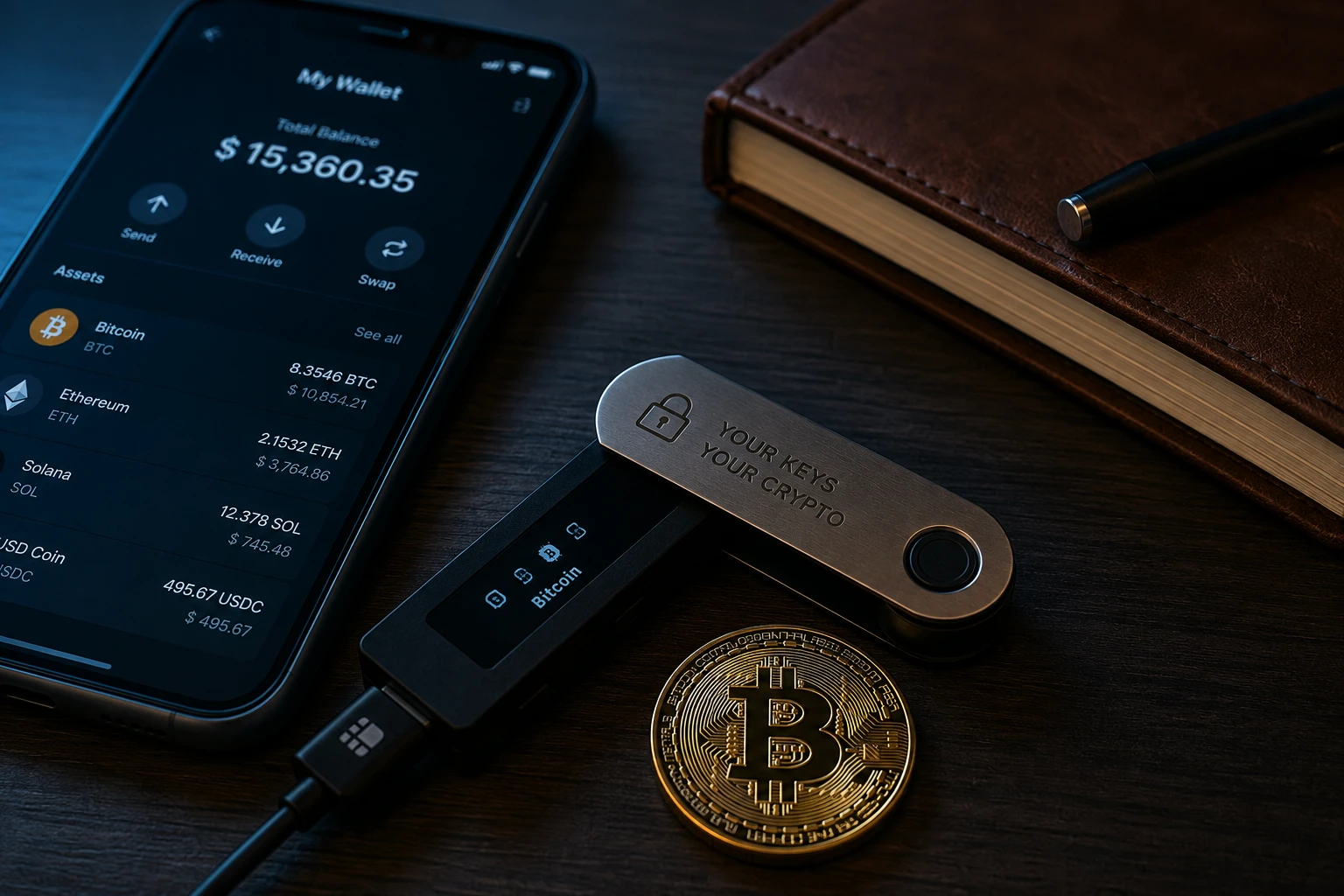
- If you are holding something meaningful for years, non-custodial with a hardware wallet is the standard answer, and the reason is simple. No company failure can take it.
- If you trade often, most people end up running both.
And if you know, honestly, that you would lose the piece of paper, that is a real answer too. Pick the one that matches how you actually behave, not how you would like to.
Either way, read how an app describes its own custody in its own terms. That is how I would check Nika, and how I would check anyone else.
Frequently asked questions
Is a non-custodial wallet safer than a custodial one?
Not automatically. It removes the risk of a company failing or freezing your account and replaces it with the risk of losing your own access, which nobody can reset. Safer depends on which risk you are better placed to manage.
Can a non-custodial wallet be hacked?
The software is rarely the weak point. Losses come overwhelmingly from people being tricked into signing something. Self-custody protects you from a company failing, not from being fooled.
Do non-custodial wallets need KYC?
The wallet usually does not, since there is no account to open. Apps built around one often do, for regulated features like fiat on-ramps. Non-custodial and no-KYC are not the same thing.
Can I use one recovery phrase in different wallets?
Yes, if both follow the same standards. That is the whole point of it. The phrase belongs to the key, not to the app that generated it.
What happens to my crypto if the app shuts down?
Nothing. It was never in the app. You restore in different software and carry on, which is exactly what you cannot do when a custodial platform fails.
Custodial and non-custodial are not good and bad. They are two answers to one question: who holds the keys, and who eats the loss when something breaks. Pick deliberately, and test your backup before you need it.
Declaration: Nothing here is financial advice. Consider your own circumstances, or speak to a licensed adviser, before moving money.