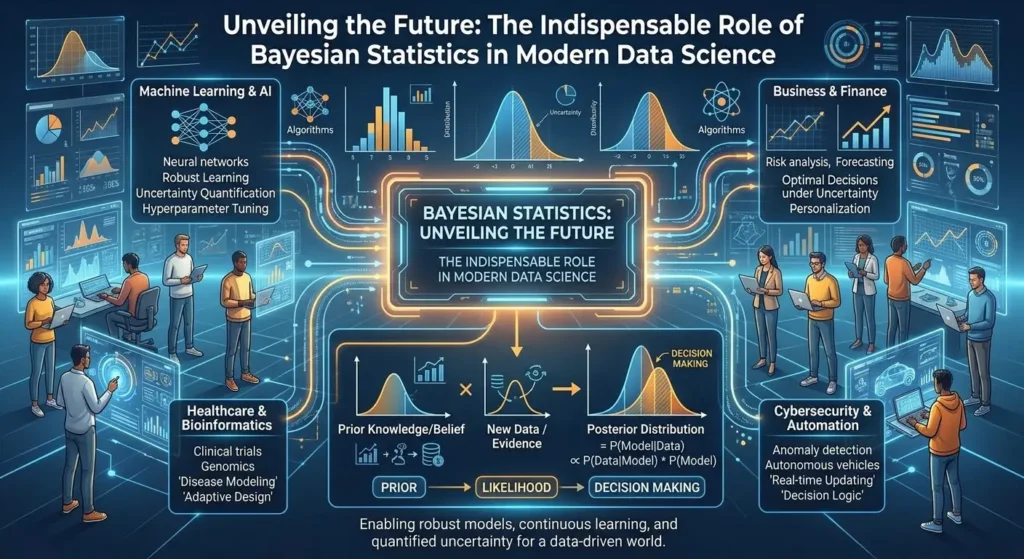
Now that there is an enormous amount of information available and since every click, each transaction and every sensor reading generates a huge quantity of raw data, the ability to draw meaningful insights is not just a technical skill—it is an art of interpreting the universe. At its heart, modern data science is akin to an oracle in the digital age. Unlike a soothsayer who relies on a static crystal ball, it is more like a highly sophisticated seer who collects a large number of faint whispers, detects subtle patterns, and continuously refines his or her understanding of the world in order to predict possibilities and help with decision-making. This type of oracle does not provide definite and unchangeable predictions; instead, it offers probabilistic visions, acknowledging the uncertainty inherent in the future. Of all the methods at the disposal of this advanced oracle, no one is more important and increasingly so than Bayesian statistics.
Let us start by taking a journey whose aim is to grasp the way this powerful probabilistic framework is changing the field of modern data science, moving from basic observations on to a full understanding of the underlying mechanisms and thus allowing for reliable predictions.
Beyond the Single Answer: Embracing Uncertainty with Bayesian Thinking
Envision a seasoned detective examining a tough case. A frequentist would focus completely on the most recent and impressive piece of evidence and would try to come to a “guilty” or “not guilty” decision simply on the grounds of its statistical significance. A Bayesian detective, by contrast, takes a different approach. Starting from their current beliefs—perhaps having a suspicion about a suspect or possessing information gained from past cases—they do not discard these initial beliefs when new evidence emerges (the likelihood); instead, they adjust them and arrive at a more accurate posterior belief. It is this continuous process of altering one’s beliefs in light of new data that underlies Bayesian inference.
This approach allows data scientists to escape the restrictions imposed by point estimates and simple yes-or-no conclusions. Rather than saying “the effect is X”, Bayesian methods give a distribution of possible effects, showing the full range of what might happen and measuring the uncertainty associated with each possibility. The fact that it takes this more detailed view is particularly useful when working with small datasets, complicated interventions, or in cases where prior knowledge (such as that based on expert intuition) is important. It acknowledges that in a world full of variables and uncertainties the most honest answer is seldom a single figure, but instead a confident range of plausible results.
Probabilistic Storytelling: Bayesian Modeling for Richer Insights
Imagine a cartographer who is trying to find a hidden treasure. A conventional map would indicate the spot with a single “X”, suggesting complete certainty. In contrast, a Bayesian map would show a glowing region, more concentrated in one area and gradually becoming less intense in the rest, showing the most likely location of the treasure as well as the probability of it being in nearby areas. This is what Bayesian modelling amounts to: it does not simply provide you with a ‘best fit’ line; it offers you a whole range of possible lines, each one weighted according to its probability.
The more sophisticated approach of “probabilistic storytelling” changes the way we understand various phenomena. In areas such as marketing, Bayesian A/B testing is able to draw more reliable conclusions regarding the effectiveness of a campaign even when the sample size is small, since it directly computes the probability that variation B is better than A and takes into account prior knowledge from previous similar campaigns. For those who want to improve their analytical abilities, taking a thorough data scientist course which includes these advanced techniques offers the opportunity to achieve truly insightful data interpretation. Bayesian models, by combining data with prior beliefs, produce a much more complete and believable account of reality and do not merely provide answers but also give a quantifiable measure of how much confidence one should place in those answers.
Adaptive Learning: Bayesian Inference in Dynamic Environments
The modern world is by no means static; financial markets change from minute to minute, user preferences alter, and machines wear out with time. In such dynamic situations, models which are created once and then never updated soon become outdated. Bayesian statistics emerges as the ideal framework for continuous and adaptive learning.
Picture a highly advanced thermostat that, rather than merely responding to the present temperature, learns your family’s daily routine, takes into account past weather patterns, and even predicts how long it will take your house to cool down or heat up. The more data it gathers, the more it improves its internal model, resulting in more efficient and comfortable temperature control. This is a practical example of Bayesian inference. The approach enables models to take in information one piece at a time, adjusting their parameters and making predictions in real time. Such capability is essential in areas like real-time fraud detection, where new patterns of illegal activity constantly appear, or in personalized recommendation systems, which have to adapt as users’ tastes change. For those who are eager to become proficient in such real-time adaptive systems, a modern data science course available in Bangalore or in any other major tech centre usually focuses on these latest methodologies.
The Art of Decision-Making: Bridging Data and Action with Bayesian Networks
It is not only about understanding the past or forecasting the future, but also about taking optimal decisions in complex and interconnected systems, which is exactly where Bayesian Networks prove to be extremely powerful. These graphical models show the variables and their probabilistic dependencies, enabling data scientists to draw out causal relationships and to see how a change in one variable affects the whole system.
Envision a master strategist who is planning a humanitarian aid operation in a crisis situation. He or she does not merely consider individual elements such as the availability of food or road blockages on their own. Instead, the strategist recognises how logistical bottlenecks affect the distribution of food, how the weather influences road conditions, and how all these various factors interact to impact the overall effectiveness of aid delivery. A Bayesian Network is able to model this complex network, so that decision-makers can simulate different scenarios, spot the key choke points, and assess the likely results of various intervention strategies in conditions of uncertainty. This ability turns raw data into actionable intelligence and thus allows for more informed and resilient decision-making in high-pressure situations, whether in the field of medical diagnostics or in supply chain management. The level of understanding gained by mastering this aspect of data analysis means that a good data science course in Bangalore becomes an excellent resource for those who wish to enter the field of data professionals.
Overcoming the Computational Hurdle: MCMC and the Rise of Practical Bayesianism
For many years the computational complexity of Bayesian methods meant that their mathematical elegance was often overlooked. It was a difficult task to calculate the posterior distribution, particularly with models that have a large number of parameters. Nevertheless, the introduction of advanced algorithms such as Markov Chain Monte Carlo (MCMC) methods changed the situation. MCMC works in a manner similar to a smart explorer, systematically moving around the large, multi-dimensional space of a posterior distribution and taking samples which step by step come to resemble its actual shape without having to calculate all the points thoroughly.
This computational advance, together with the continuous increase in processing power and the creation of easy-to-use probabilistic programming languages (such as PyMC and Stan), has meant that complex Bayesian modelling is now accessible and practical when dealing with ordinary data science problems. Since these tools are so accessible, people who take a well-structured data scientist course can gain hands-on experience with these powerful libraries and thus be able to make use of the full advantages of Bayesian methods without having to get bogged down by the detailed mathematical computations required for each task.
Conclusion
As the digital oracle of modern data science continues to develop, its insights become more refined, the accuracy of its predictions increases, and the value of its advice rises accordingly. Bayesian statistics, with its ability to deal naturally with uncertainty, to combine existing knowledge with new evidence, to adjust to changing conditions, and to model complex causal relationships, is not merely yet another tool at the disposal of the data scientist. It is a fundamental philosophy that allows us to go beyond simple correlation and attain a deeper, probabilistic understanding of the world. For anyone who really wants to master the art of interpreting data and making predictions, a future based on Bayesian thinking is not only possible—it is a necessity.
Business name: ExcelR – Data Science, Data Analytics Course Training in Pune
Address: 101 A ,1st Floor, Siddh Icon, Baner Rd, opposite Lane To Royal Enfield Showroom, beside Asian Box Restaurant, Baner, Pune, Maharashtra 411069
Phone: 098809 13504