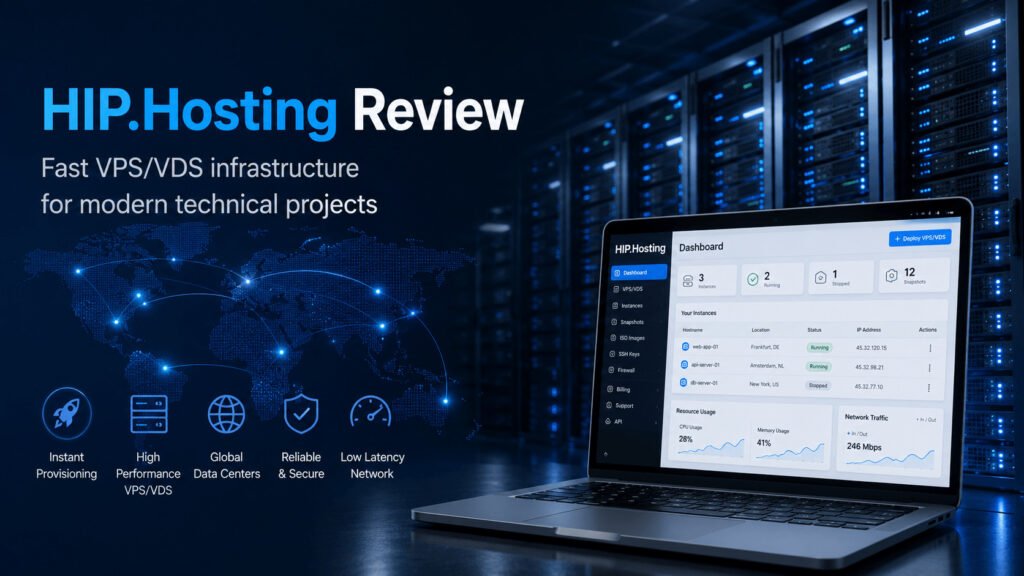
Choosing a virtual server sounds simple until you actually have to do it. You start comparing CPU cores, RAM, storage, locations, virtualization technologies and network capacity, and suddenly a decision that should take ten minutes turns into an evening of research. For developers and businesses, the real question isn’t just “How much RAM do I get?” It is whether the server gives you enough control, performance and flexibility to build without constantly worrying about the infrastructure underneath it.
That is where HIP-Hosting caught my attention. It is a VPS/VDS-focused hosting platform built around KVM virtualization, root-level server control, quick provisioning and a selection of international server locations. Instead of trying to complicate things with dozens of unrelated services, the platform keeps its attention on virtual servers for developers, administrators and businesses that want more control over their hosting environment. HIP.Hosting states that its servers can be provisioned in less than a minute, making the initial deployment process particularly straightforward.
What Is HIP.Hosting?
HIP.Hosting is a virtual server provider offering different VPS/VDS configurations depending on the type of workload you need to run.
The platform divides its servers into categories such as Standard, Memory and Hi-CPU VPS/VDS. This makes more sense than forcing every customer into the same type of configuration.
A typical website or application may need a balanced combination of processing power, memory and storage. A database-heavy project might benefit from additional RAM, while a computational workload may benefit more from stronger CPU performance.
HIP.Hosting’s Standard VPS/VDS range is specifically positioned as a balanced option for everyday workloads, while other configurations are available for projects with different resource requirements.
This flexibility matters because no two technical projects are exactly alike.
A small staging environment and a growing SaaS application shouldn’t require the same server.
A Simple Approach to VPS Management
Server management can be intimidating, particularly for someone moving from managed platforms to infrastructure where they have complete control.
HIP.Hosting tries to reduce some of that friction through its own control panel.
From there, users can select resources, choose an operating system, deploy a server and manage their virtual machine. The provider also advertises the ability to scale a server in a few clicks.
That may sound like a small convenience, but anyone who has managed multiple servers knows how quickly unnecessary complexity becomes frustrating.
Sometimes you simply want to deploy an instance and start configuring Nginx, Docker, your database or your application.
HIP.Hosting supports popular operating-system options including Ubuntu, Debian, AlmaLinux, Rocky Linux, Fedora, Arch Linux and Windows.
Once the virtual server is created, users receive root-level control over the environment.
And this is one of the biggest reasons people choose VPS/VDS infrastructure in the first place.
You aren’t limited to a predefined software stack.
Want to install Docker? You can.
Need a particular version of Node.js?
Install it.
Want to configure Nginx, PostgreSQL, Redis and your own firewall rules?
You have that freedom.
For developers, that freedom is often worth far more than another fancy dashboard feature.
Fast Server Provisioning Makes Experimenting Easier
One of the features HIP.Hosting emphasizes heavily is provisioning speed.
According to the company, a new server can be ready in less than one minute.
That becomes particularly useful when VPS instances aren’t permanent infrastructure.
Imagine you’re a developer preparing a demo for a client.
You need a clean Ubuntu server, Docker installed and an application running before tomorrow morning. Being able to deploy an instance almost immediately means you’re spending your time building the project instead of waiting for infrastructure.
The same idea applies to testing environments.
A development team could spin up an isolated VPS for experimentation, deploy a new build, perform its tests and then decide how it should be incorporated into production.
Fast provisioning doesn’t make an application faster by itself, but it removes one of those small annoyances that slows down technical work.
And when you’re working against a deadline, those small annoyances feel much bigger.
KVM Virtualization and Resource Isolation
HIP.Hosting uses KVM virtualization for its VPS/VDS infrastructure.
KVM is particularly attractive for users who want a virtual machine that behaves much like an independent server environment.
Each VPS operates inside its own isolated virtual environment with allocated resources and its own operating system.
That isolation is important when you’re running serious applications.
A developer may be hosting several Docker containers. A business may have an internal dashboard connected to a database. Another user might be operating APIs that process thousands of requests throughout the day.
Having a properly isolated virtual environment gives administrators significantly more control over how the system is configured.
It also makes VPS/VDS infrastructure useful for teams that need custom networking, security rules, system packages or services that wouldn’t fit neatly into a predefined environment.
NVMe Storage Matters More Than People Think
CPU and RAM usually receive most of the attention when people compare VPS plans.
Storage performance is sometimes treated as an afterthought.
That can be a mistake.
Your application constantly interacts with storage. Logs are being written. Database records are being read. Cache files are created. Packages are installed. Containers are being started and updated.
HIP.Hosting states that its compute nodes use datacenter-grade NVMe storage from vendors including Intel and Samsung.
NVMe storage can be particularly useful for workloads involving frequent disk operations.
Think about:
- database-driven applications,
- content management systems,
- development servers,
- API platforms,
- containerized services,
- automation tools,
- analytics applications,
- and applications processing large numbers of small files.
Storage isn’t the only factor determining application performance, of course. Your code, database architecture, caching strategy and network latency are all important.
But starting with fast storage removes one potential bottleneck from the equation.
Hardware Designed for Different Workloads
HIP.Hosting also publishes information about some of the processors used across its infrastructure.
Its documentation lists server CPUs such as Intel Xeon E5-2699 v4 and Xeon Gold 6238R for various Standard and Memory locations. Certain Hi-CPU infrastructure is documented with processors including AMD Ryzen 3800X and Intel Core i9 models. Hardware availability varies between locations and server categories.
This distinction is important.
A project that mostly stores information doesn’t necessarily need the same CPU characteristics as a heavily computational application.
Having Standard, Memory-oriented and CPU-oriented configurations gives technical users the ability to spend their infrastructure budget where it actually matters.
There’s little benefit in paying for huge amounts of RAM if your application is CPU constrained.
Likewise, buying additional processing power won’t solve a workload that constantly runs out of memory.
The best VPS isn’t always the most powerful one.
It’s the one whose resources match the application.
International VPS Locations
Server location is another factor that is easy to underestimate.
If your customers are primarily in Europe but your application is running thousands of kilometres away, network latency can become noticeable.
HIP.Hosting currently lists VPS/VDS locations across several countries and cities, including locations in France, the Netherlands, the United States, Finland, Poland, the United Kingdom, Sweden, Latvia, Germany, Estonia and Russia, although actual inventory can vary and some locations may temporarily be unavailable. Lithuania is also listed by the company as a planned location.
Having different regions available provides an important advantage: deployment flexibility.
You can position infrastructure closer to the people or systems that need to access it.
A European application could run from a European location.
A service primarily targeting American users could choose infrastructure in the United States.
A company operating several services could even distribute different workloads between locations.
For businesses expanding internationally, this becomes increasingly valuable.
Infrastructure doesn’t have to remain tied to one geography.
Reliability and Network Availability
Performance means little if the server isn’t reachable when customers need it.
HIP.Hosting advertises 99.8% uptime for its VPS/VDS infrastructure alongside unlimited bandwidth on its plans.
As with any infrastructure provider, businesses operating mission-critical systems should maintain their own monitoring, backups and redundancy strategy rather than relying entirely on a provider-level uptime figure.
That isn’t unique to HIP.Hosting.
It’s simply good system administration.
Monitoring tools should tell you whether an endpoint becomes unavailable. Databases should have reliable backups. Important configuration should be version controlled. Applications generating revenue should have a recovery plan.
Good infrastructure is one piece of reliability.
Good engineering is the other.
Where Can You Actually Use a HIP.Hosting VPS?
The interesting thing about a VPS is that its value isn’t tied to one application.
Once you have root access to a server, you can build an environment around your own requirements.
Web Applications
Developers can deploy applications built using technologies such as Node.js, PHP, Python, Java, Go or other server-side frameworks.
A typical VPS might run:
Nginx → Application → Database → Redis
Everything can live inside one virtual server for a smaller project or be separated across multiple instances as the architecture grows.
Docker and Microservices
A VPS also works well for containerized applications.
Docker allows teams to package their application and dependencies together, making deployments much more predictable.
For smaller microservice architectures, separate VPS instances can host different components while developers maintain direct control over the environment.
Databases
Memory-focused configurations can be useful for database workloads.
Depending on available resources, administrators could operate systems such as PostgreSQL, MySQL, MariaDB, MongoDB or Redis.
For sensitive production data, proper backups, encryption and security configuration remain essential.
Development and Testing
This might be one of the most underrated uses of inexpensive VPS infrastructure.
Instead of experimenting directly on your production server, create a separate environment.
Break things there.
Upgrade packages.
Test the new application version.
Change the database.
Experiment with Docker.
If something goes wrong, your customers don’t even know it happened.
For developers, having somewhere safe to make mistakes is incredibly useful.
Automation
Virtual servers are also useful for running automation workflows and self-hosted software.
Interestingly, HIP.Hosting’s documentation includes application instructions for tools such as n8n, indicating that automation workloads are among the environments its users can deploy.
A VPS running continuously can execute workflows, webhooks, scheduled jobs and background processes without depending on your personal computer.
Commercial Websites
Growing online businesses often reach a stage where having greater infrastructure control becomes attractive.
With a VPS, administrators can tune server software, implement caching, configure security policies and allocate resources around the application’s actual requirements.
This can be particularly useful for e-commerce systems, SaaS dashboards, client portals and other commercial applications where configuration flexibility matters.
Scalability Without Overcomplicating Things
Every successful online project eventually faces the same question:
What happens when traffic grows?
In the beginning, you may only require a modest amount of CPU and memory.
Six months later, the application might be serving thousands of users.
HIP.Hosting advertises the ability to scale server resources through its control panel, giving users a path to increase capacity as requirements change.
This approach makes financial sense too.
There’s no reason for a new project to pay for infrastructure designed for traffic it doesn’t have yet.
Start with the resources you need.
Measure.
Optimize.
Then scale when the data tells you to.
That is usually a healthier infrastructure strategy than guessing how successful your project might become.
Why HIP.Hosting Is Interesting for Technical Users
What I like most about the concept behind HIP.Hosting is that the proposition is easy to understand.
You choose virtual-server resources.
You select a location.
You deploy an operating system.
You receive root access.
And then the server is yours to configure.
There are several characteristics that make the platform particularly interesting for technical projects:
KVM virtualization gives users an isolated virtual-machine environment.
Root access provides freedom to configure the operating system and software stack.
NVMe-based infrastructure can benefit applications where disk performance matters.
Multiple international locations provide greater flexibility when selecting where workloads should run.
Different resource profiles allow users to choose balanced, memory-oriented or CPU-oriented configurations rather than paying for resources they don’t need.
Fast provisioning makes launching temporary, development and production environments much more convenient.
And perhaps most importantly, a VPS gives technical teams control.
For many developers and system administrators, that is the whole point.
Things to Consider Before Choosing a VPS
No provider or server configuration is automatically right for every project.
Before deploying an application, think carefully about what actually matters to you.
Where are your users located?
How much RAM does your application genuinely consume?
Is your workload CPU intensive?
How much storage will you need six months from now?
How important is latency?
Do you have proper backups?
How will you monitor uptime?
These questions matter more than simply choosing the plan with the largest numbers.
I’d also recommend testing any new infrastructure with a smaller workload before moving a business-critical application. Run benchmarks relevant to your software, monitor network performance and make sure the environment behaves the way you expect.
Real-world performance is always more useful than a specification sheet.
Final Thoughts
VPS hosting is ultimately about freedom.
Freedom to install your own software.
Freedom to configure the operating system.
Freedom to choose where your server runs.
Freedom to scale your infrastructure as the project grows.
And freedom to build an environment around your application instead of redesigning your application around the limitations of the environment.
HIP.Hosting brings those advantages together through KVM-based VPS/VDS infrastructure, NVMe storage, multiple server configurations, international locations, root access and rapid server deployment.
For developers, system administrators, webmasters and digital businesses that are comfortable managing their own server environment, it is an interesting option to consider.
The most sensible approach is the same one I recommend with almost any infrastructure provider: begin with the requirements of your project rather than the marketing.
Choose an appropriate location.
Choose enough resources.
Deploy the server.
Test your real workload.
And build from there.
Because when infrastructure works properly, you shouldn’t spend your day thinking about the server.
You should be thinking about what you’re going to build on it.