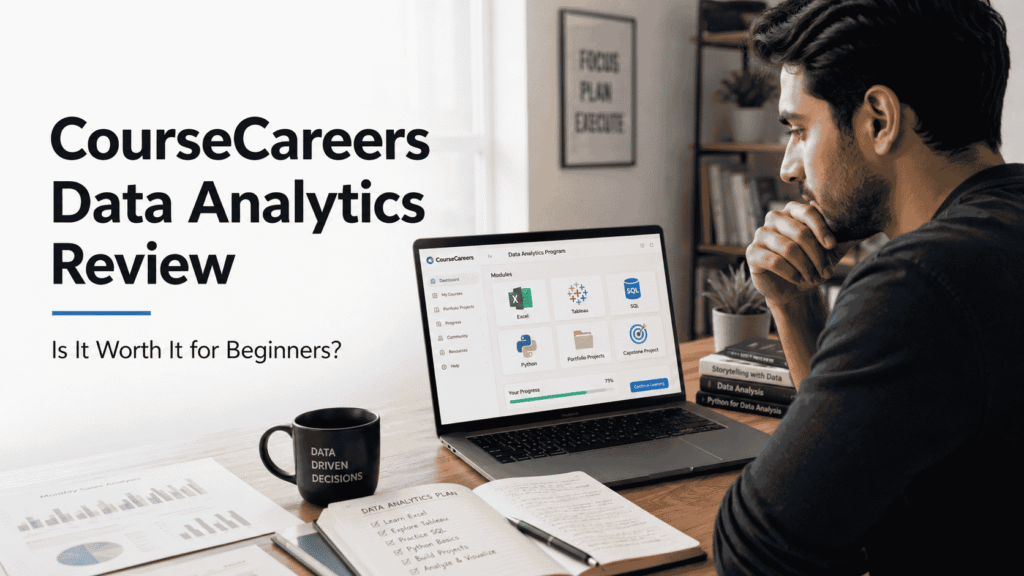
If you’ve been searching for a CourseCareers Data Analytics review, you’re probably not trying to figure out whether data analytics is popular.
You already know that.
You’re probably asking a much more uncomfortable question:
Is this course actually worth $499, or am I paying hundreds of dollars for information I could learn on YouTube for free?
That’s exactly the question I wanted to answer.
Because CourseCareers makes an attractive promise. Learn the skills needed for an entry-level data analytics career without spending thousands on a traditional bootcamp.
But a good landing page doesn’t automatically mean a good course.
So I looked deeper into the CourseCareers Data Analytics course, including its curriculum, projects, tools, pricing, career preparation, certificate value, and the areas where beginners may struggle.
And my conclusion is pretty simple:
CourseCareers Data Analytics can be a very good starting point for a beginner, but it is definitely not the final step in becoming a strong data analyst.
If you want to look at the program yourself while reading this review, you can explore the CourseCareers Data Analytics course here.
Disclosure: The link above is an affiliate link. I may earn a commission if you make a qualifying purchase through it, at no additional cost to you. This does not affect the positives or negatives discussed in this review.
What Is the CourseCareers Data Analytics Course?
The CourseCareers Data Analytics course is designed primarily for beginners who want to understand how data analysts actually work and develop the basic skills required for entry-level analytics roles.
You don’t need previous programming experience to begin.
Instead of throwing Python at you on day one and hoping you survive, the program builds gradually through the tools commonly associated with data analytics.
The course covers areas including:
- Data analytics fundamentals
- Excel
- Tableau
- SQL
- Python
- Portfolio projects
- Interview preparation
- Job-search strategies
According to the detailed course review provided for this article, the program contains roughly 10 hours of recorded video lessons, 22 hands-on exercises, four portfolio projects, a practice exam, and a proctored final exam.
At first, 10 hours of video might sound surprisingly short.
But that’s actually missing the point.
The program appears to rely heavily on exercises and projects rather than expecting you to sit through 50 hours of lectures.
And personally, I think that’s the better approach for something like data analytics.
You don’t learn SQL by watching somebody type SQL.
Eventually, you need to type the query yourself.
CourseCareers Data Analytics Cost
At the time of the source review, the CourseCareers Data Analytics cost was:
$499 when paid upfront
or
4 biweekly payments of $150, which comes to $600 overall.
So the installment option gives you more flexibility, but it costs more in total.
The course is self-paced, and the suggested completion time is around 8 to 14 weeks, although you can move faster or slower depending on your schedule.
Before paying anything, I would recommend checking out the introductory content and curriculum first.
You can view the CourseCareers Data Analytics program here.
What Do You Actually Learn?
This is where the CourseCareers Data Analytics course review becomes more interesting.
The course does not focus on one tool.
Instead, it tries to introduce you to the main workflow of an entry-level analyst.
1. Data Analytics Foundations
The beginning of the course focuses on understanding what data analysts actually do.
This might sound boring compared with jumping straight into Python, but I think beginners desperately need this section.
It’s easy to fall into the trap of thinking:
“If I learn SQL, Excel and Python, I’m automatically a data analyst.”
Not really.
The tools are only tools.
The real job is using data to answer questions and help a business make better decisions.
The introductory section helps explain the difference between simply learning software and actually thinking like an analyst.
2. Excel
Yes, Excel.
And no, Excel isn’t dead.
The course teaches you how spreadsheets are used for cleaning, organizing, analyzing and summarizing data.
The student review specifically highlighted areas such as:
- Structuring datasets
- Using formulas and functions
- Pivot tables
- Charts
It also includes a project using box-office data, giving students a chance to apply what they’ve learned rather than simply memorize formulas.
For beginners, I actually like that CourseCareers starts here.
Excel gives you quick wins.
You can see what you’re doing.
You can make mistakes without feeling like you’ve accidentally broken the internet.
That builds confidence before you reach the more intimidating parts.
3. Tableau
The Tableau section appears to be one of the stronger parts of the course.
Instead of simply teaching students to create pretty charts, the focus is on turning data into something another person can understand.
Students work on connecting datasets, selecting chart types, and building dashboards that communicate insights.
This matters because nobody hires a data analyst because they can create the most colorful graph.
Employers care whether you can look at a dataset and explain:
“Here’s what happened, here’s why it matters, and here’s what we should probably do next.”
That’s the actual skill.
4. SQL
This is where the course becomes more technical.
The SQL section progresses from basic queries into topics such as joins, subqueries and window functions.
For somebody who has never worked with databases, SQL can initially feel strange.
You write a few lines of code, hit run, get an error, stare at your screen for 15 minutes…
Then realize you forgot a comma.
Welcome to analytics.
The important thing is that the course seems designed to give students a functional foundation, rather than pretending a beginner will become an advanced SQL engineer after one module.
That’s realistic.
5. Python
Python is included, but this is also one of the areas where you need realistic expectations.
The course introduces basic Python concepts, working with data and simple visualization with Matplotlib.
But this isn’t a full Python programming course.
And I actually think CourseCareers is better off being honest about that approach.
The goal seems to be:
“Understand where Python fits into data analytics and become comfortable enough to continue learning.”
Not:
“Become a Python expert in two weeks.”
If you’re eventually targeting advanced analytics, automation, data science or machine-learning roles, you will absolutely need to continue learning beyond this course.

The Portfolio Projects Are More Important Than the Certificate
This is one of the most important things I can tell you in this CourseCareers Data Analytics review.
Don’t obsess over the certificate.
The program includes portfolio projects, and those projects may ultimately be far more important for demonstrating your skills than simply writing “CourseCareers Certificate” on your resume.
The course review describes four portfolio projects alongside the hands-on exercises.
That’s valuable because if an interviewer asks:
“Can you show me something you’ve analyzed?”
you need a better answer than:
“I watched all the videos.”
Projects give you something to discuss.
What problem were you solving?
What data did you use?
Why did you choose that visualization?
What did you discover?
What would you do differently?
Those conversations are where your knowledge becomes visible.
What I Like About CourseCareers Data Analytics
After going through the program structure and the detailed review, there are several things I think CourseCareers gets right.
Beginner-Friendly Structure
The biggest strength is probably the learning progression.
Excel comes before SQL and Python.
Business context comes before advanced tooling.
Exercises follow lessons.
Projects force you to use what you’ve learned.
That makes the program much less overwhelming for someone starting from zero.
Practical Instead of Extremely Theoretical
Some people genuinely enjoy sitting through hours of theory.
I’m not one of them.
And if you’re trying to change careers, you probably want to feel like you’re actually moving toward something useful.
The CourseCareers program emphasizes exercises, dashboards, queries and projects rather than purely theoretical lectures.
That’s a big positive.
The Main Tools Are Covered
You get exposure to:
Excel + Tableau + SQL + Python
That’s a sensible toolkit for somebody exploring entry-level data analytics.
It won’t make you advanced in every tool, but it gives you enough exposure to figure out what analytics work feels like.
Career Preparation Is Included
The final part of the course covers resume building, LinkedIn optimization, interviews and job-search strategies.
I like this because learning technical skills and getting hired are two completely different problems.
You can know SQL and still have a terrible resume.
You can build impressive dashboards and still completely freeze during an interview.
Career preparation doesn’t guarantee a job, but beginners often need guidance here.
What I Don’t Like
Now for the part that most affiliate reviews conveniently forget.
CourseCareers Data Analytics isn’t perfect.
Some Topics Don’t Go Very Deep
The biggest weakness is also a consequence of what makes the course beginner-friendly.
It covers a lot of tools.
But when one program teaches Excel, Tableau, SQL, Python, projects and career preparation, it can’t go extremely deep into everything.
The source review specifically notes that SQL and Python are introduced but not covered deeply enough for advanced analytics or data science work.
So don’t finish this course and think:
“Great, I’ve completed data analytics forever.”
You’ve started.
That’s different.
Real Data Is Often Much Messier
Tutorial datasets are usually friendly.
Real-world datasets sometimes look like they were created by five different people who hated each other.
Missing values.
Inconsistent formats.
Duplicate rows.
Strange column names.
No documentation.
Requirements that change halfway through your analysis.
The review notes limited exposure to messy, unstructured data and some of the ambiguity analysts face in real working environments.
You’ll need independent practice with real datasets after the course.

The Certificate Alone Probably Won’t Get You Hired
This is important.
A CourseCareers Data Analytics certificate can show that you’ve completed structured training.
But don’t treat it like a magic employment ticket.
The detailed review itself argues that the real value is the practical understanding and direction gained from the program, rather than the certificate alone.
Your portfolio, technical ability, interview performance and ability to explain your work will matter much more.
Can You Get a Job After CourseCareers Data Analytics?
Possibly.
But CourseCareers cannot guarantee it.
And neither can I.
The course gives you a foundation and career guidance, but actually landing a data analytics job depends on factors such as:
- Your understanding of Excel, SQL, Tableau and Python
- Portfolio quality
- Communication skills
- Interview performance
- Job market conditions
- How many jobs you apply for
- Whether you continue practicing after finishing the course
The student review makes the same point: completing the course does not guarantee employment, and students still need strong projects, understanding, interview skills and additional practice.
That’s the expectation I would have before enrolling.
Who Should Take CourseCareers Data Analytics?
I think this course makes the most sense if:
- You’re completely new to data analytics
- You’re switching from a non-technical career
- You feel overwhelmed by random YouTube tutorials
- You want a structured roadmap
- You learn better by completing exercises
- You want projects for your portfolio
- You want an introduction to Excel, Tableau, SQL and Python
- You understand that learning will continue after the course
The source review reaches a similar conclusion, describing the course as best suited to beginners and people from non-technical backgrounds who want a clear route into entry-level analytics.
Who Should Probably Skip It?
I would think twice if:
You already know SQL and Python well.
You’ll probably find parts too basic.
You want advanced data science training.
This isn’t a machine-learning or advanced statistics program.
You’re looking for a guaranteed job.
No course can realistically promise that.
You’re already good at teaching yourself.
If you can build your own curriculum, find datasets, create projects and stay disciplined without external structure, you may be able to learn much of this independently.

Is CourseCareers Data Analytics Worth It?
So here’s my final verdict.
For a complete beginner, I think CourseCareers Data Analytics is worth considering.
Not because there’s secret information hidden inside the course.
There isn’t.
You could theoretically learn Excel, Tableau, SQL and Python separately for free.
What you’re paying for is something different:
A roadmap.
Instead of opening YouTube and asking:
“Should I learn SQL first?”
“Do I need Python?”
“Should I learn Power BI or Tableau?”
“What projects should I build?”
“How do I make a data analyst resume?”
you get one structured path.
And for someone who has spent months consuming random tutorials without actually progressing, that structure can be incredibly valuable.
But I would treat the course as a launchpad, not the finish line.
The source review makes essentially the same recommendation: use CourseCareers to build the foundation, then continue practicing with real datasets and personal portfolio projects.
That’s probably the healthiest way to approach it.
👉 Explore the CourseCareers Data Analytics Course
Start by looking through the introductory material and curriculum.
If the teaching style clicks with you and you want somebody to give you a structured path, the full course may be worth the investment.
If you look at the material and immediately feel:
“I could build this roadmap myself.”
Then save your $499.
A course is valuable only when it solves a problem you actually have.
CourseCareers Data Analytics Review: FAQs
Is CourseCareers Data Analytics good for beginners?
Yes. The program is specifically structured around beginners and introduces the tools gradually. Previous programming experience isn’t required.
What does CourseCareers Data Analytics teach?
The course covers data analytics fundamentals, Excel, Tableau, SQL, Python, portfolio projects, interview preparation and job-search strategies.
How much is CourseCareers Data Analytics?
The source reviewed for this article lists the course at $499 upfront or four payments of $150.
Does CourseCareers Data Analytics teach Python?
Yes, but at a beginner level. It introduces Python syntax, basic data work and visualization rather than attempting to provide advanced Python training.
Does CourseCareers teach SQL?
Yes. The curriculum progresses from basic SQL queries into concepts such as joins, subqueries and window functions.
Is the CourseCareers Data Analytics certificate enough to get a job?
The certificate alone should not be expected to get you hired. Your projects, skills, interview performance and ability to explain your analysis are more important.
Where can I check the CourseCareers Data Analytics course?
You can visit the CourseCareers Data Analytics course here and look through the program before deciding whether it fits your learning goals.