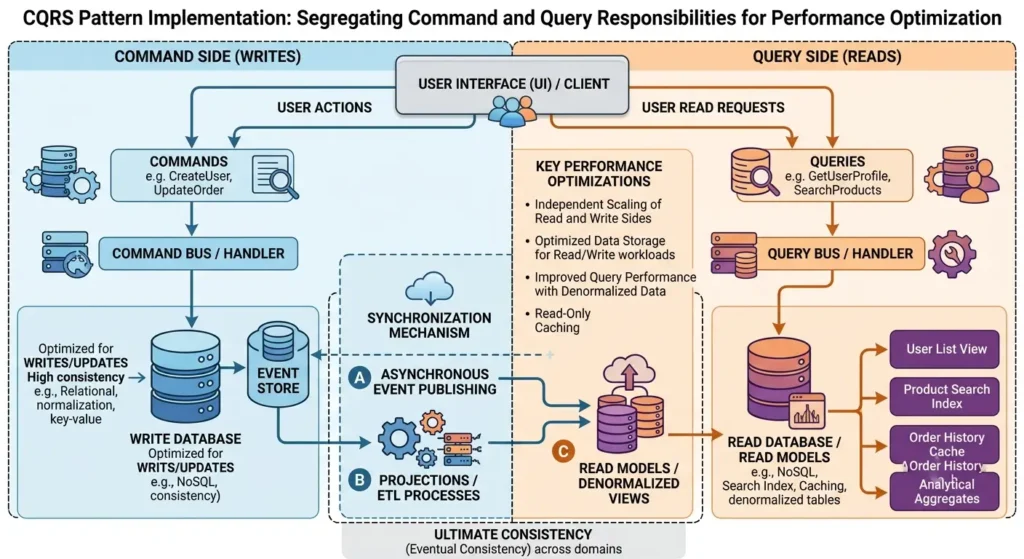
In large-scale applications, balancing performance, scalability, and consistency is a constant architectural challenge. The Command Query Responsibility Segregation (CQRS) pattern offers a powerful solution by dividing the responsibilities of data modification (commands) and data retrieval (queries) into separate models. This separation allows developers to fine-tune each side for optimal performance and flexibility—especially in distributed systems where responsiveness and fault tolerance are key. Students enrolled in full stack developer classes often encounter CQRS as a cornerstone of advanced backend design patterns.
Understanding the CQRS Pattern
The CQRS pattern extends from the basic concept of Command Query Separation (CQS) proposed by Bertrand Meyer. CQS emphasizes that methods should either modify state (commands) or return data (queries)—but never both. CQRS scales this concept to system architecture by separating read and write operations into different components.
- Command Side: Handles operations that change data, such as create, update, or delete requests.
- Query Side: Focuses solely on reading and presenting data efficiently, often optimized through caching or denormalized data structures.
By using CQRS, developers can independently evolve and optimize these two operations without creating dependencies that slow performance. Learners in a full stack course find this concept vital when dealing with complex enterprise systems that demand speed and scalability.
Benefits of Implementing CQRS
1. Performance Optimization
Traditional CRUD architectures often experience bottlenecks because both read and write operations rely on the same database schema. In CQRS, queries can use specialized read models designed for high performance, while commands can ensure strict consistency for data changes. This division enables low-latency reads and faster user experiences.
2. Scalability
CQRS supports horizontal scaling by allowing independent scaling of read and write models. For example, high-traffic APIs can deploy multiple read replicas for queries while maintaining a single write node for consistency. This approach aligns well with cloud-native architectures, making it ideal for applications built using microservices.
3. Enhanced Maintainability
Since command and query operations are segregated, developers can make changes to one side without affecting the other. This reduces coupling, simplifies testing, and makes codebases more modular. Those enrolled in full stack developer classes can appreciate how CQRS simplifies the management of large, evolving systems.
4. Improved Security and Validation
CQRS allows fine-grained access control by applying different security rules to commands and queries. For instance, users may have permission to view records but not to modify them. This design provides clarity and reduces the risk of unintended data alterations.
Core Components of CQRS Architecture
1. Command Handlers
Command handlers process user requests that modify data, such as “AddOrder” or “UpdateCustomerDetails.” They are responsible for executing business logic and validating data before committing changes to the database.
2. Query Handlers
Query handlers fetch and return data, often in preformatted structures optimized for user interfaces or reporting tools. These handlers can connect to separate read databases or caches, enhancing response speed.
3. Event Store and Messaging
In advanced CQRS implementations, commands generate events stored in an event store. These events can trigger updates to the query side asynchronously, ensuring that both models remain eventually consistent. Technologies like Kafka or RabbitMQ are commonly used to handle these event streams efficiently.
4. Read and Write Databases
The write database enforces transactional integrity and normalization, while the read database may use denormalized views, indexes, or NoSQL stores to speed up data retrieval. This separation is key to optimizing system performance in large deployments.
Implementing CQRS in Practice
Step 1: Model Separation
Define distinct data models for reads and writes. For example, a CustomerWriteModel for transactional operations and a CustomerReadModel for queries. This clear boundary prevents overlap in responsibilities.
Step 2: Apply Asynchronous Messaging
Use message queues or event-driven systems to synchronize the write and read sides. This ensures updates propagate reliably even in distributed environments.
Step 3: Introduce Caching for Read Optimization
Incorporate caching layers such as Redis or ElasticSearch to accelerate query performance. By serving most reads from cache, the application can handle spikes in traffic without compromising user experience.
Step 4: Monitor Event Consistency
Implement monitoring to track event propagation delays between the command and query models. This ensures system reliability and accurate data presentation.
Step 5: Integrate with Frameworks and Tools
Modern frameworks like .NET, Spring Boot, and Node.js (with TypeORM or Sequelize) offer libraries and design patterns to implement CQRS efficiently. Learners exploring a full stack course can practice CQRS by building modular backend services using these technologies.
Common Challenges and Solutions
- Data Synchronization:
Maintaining consistency between the read and write models can be complex. Employing event sourcing or transactional outboxes helps ensure reliability. - Increased Complexity:
While CQRS provides scalability benefits, it introduces additional architectural components. Beginners should start with simpler CRUD models before transitioning to CQRS once system demands grow. - Eventual Consistency:
CQRS systems often rely on eventual rather than immediate consistency. Applications must handle temporary data discrepancies gracefully, especially in user interfaces.
Use Cases of CQRS
- E-Commerce Platforms: To separate inventory updates from product catalog queries.
- Banking Systems: For handling transactions independently of account summary views.
- Social Media Applications: Where post creation (commands) and feed retrieval (queries) require different performance optimizations.
- IoT and Analytics Dashboards: Where frequent reads demand faster response times without affecting write operations.
Conclusion
The CQRS pattern offers a strategic advantage for applications that require high scalability, modularity, and optimized performance. By decoupling reads from writes, organizations can design systems that are both flexible and efficient. For aspiring developers, mastering CQRS through full stack developer classes provides valuable insight into building resilient and high-performance architectures. As part of a comprehensive full stack course, understanding this pattern not only enhances technical skill but also prepares professionals to design enterprise-grade systems that handle real-world complexities with precision.
For more details visit us:
Name: Full Stack Developer Course In Mumbai
Address: Tulasi Chambers, 601, Lal Bahadur Shastri Marg, near by Three Petrol Pump, opp. to Manas Tower, Panch Pakhdi, Thane West, Mumbai, Thane, Maharashtra 400602
Phone: 095132 62822
Email: fullstackdeveloperclasses@gmail.com