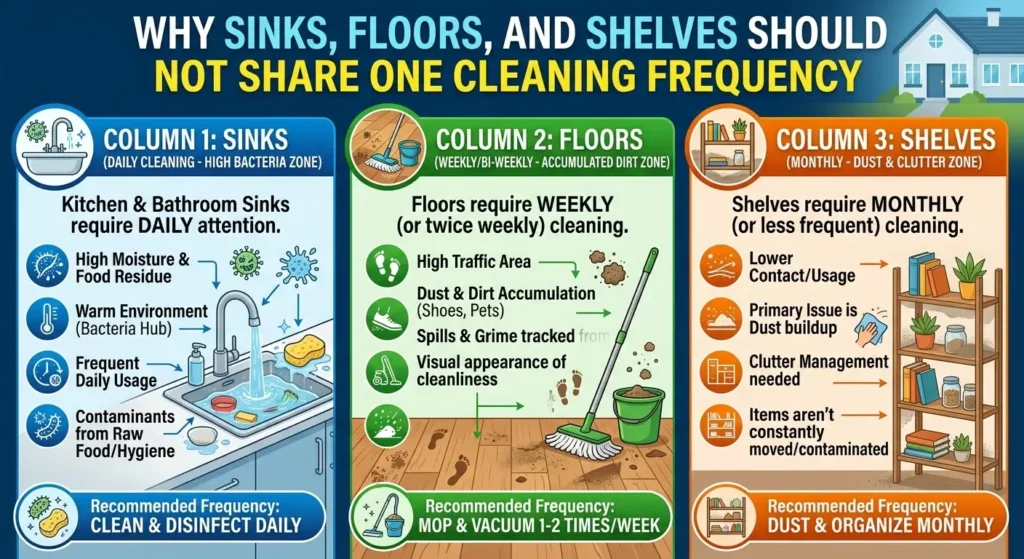
A sink can show new residue within hours.
A busy floor may collect crumbs, hair, and grit by the end of the day.
A high shelf in the same room might look almost unchanged for weeks.
Yet cleaning schedules often treat all three surfaces as though they belong on the same clock.
That creates unnecessary work in some places and delayed attention in others.
A better approach is to base frequency on how quickly a surface changes, what kind of residue reaches it, and how much contact it receives.
The whole home does not need one cleaning interval.
Different surfaces operate at different speeds.
Sinks Change Fast Because They Stay Active
Kitchen and bathroom sinks receive repeated use.
Water runs across them. Soap, food residue, toothpaste, hair, and other materials can appear throughout the day.
That activity makes sinks fast-changing surfaces.
A sink that looked clean yesterday may already show dried water spots, residue around the drain, or marks near the faucet.
This is why sink cleaning often belongs on a shorter cycle than shelves or decorative surfaces.
The frequency comes from use, not because sinks are inherently harder to clean.
Floors Change According to Traffic
Flooring follows a different pattern.
A kitchen floor may collect debris quickly because cooking and eating happen above it.
An entry floor changes because shoes bring material inside.
A guest bedroom floor may stay relatively clean because few people walk through the space.
That means even floors should not all share one frequency.
Traffic determines the pace.
A narrow hallway used all day may need attention sooner than a much larger room that is rarely entered.
Square footage is not a reliable guide.
Movement is.
Shelves Often Change Slowly
Shelves may receive less direct contact than sinks or floors.
A high shelf holding books or decorative objects can accumulate dust gradually without changing much from one day to the next.
That slower buildup makes it a good candidate for a longer interval.
The important thing is not to forget the shelf completely.
Slow-changing surfaces still need attention.
They simply do not need to compete with high-use areas every time the cleaning supplies come out.
Frequency Should Match the Speed of Change
One useful way to build a cleaning plan is to ask how long it takes for a surface to look or feel different after it is cleaned.
That surface-speed idea gives cleaning services cary nc a clearer set of priorities: sinks can sit on a shorter cycle, busy floors can follow traffic, and shelves or upper ledges can remain on a slower rotation until visible dust begins to build.
The result is not less cleaning.
It is better timing.
Each surface gets attention closer to when it actually needs it.
Water Makes Sink Residue Appear Quickly
Water changes surfaces in ways dry dust does not.
Droplets evaporate and leave marks.
Soap combines with water.
Food particles can cling to kitchen basins.
Bathroom sinks collect toothpaste, grooming residue, and splashes around the faucet.
Because these changes happen quickly, a sink may need small resets between larger cleaning sessions.
A short wipe at the right time can prevent the surface from reaching the stage where buildup becomes harder to remove.
Floors Have More Than One Dirt Source
Floor debris does not come from a single activity.
Some fall from above.
Some arrive in shoes.
Pets contribute hair.
Textiles release fibers.
Cooking creates crumbs.
That mixture means floor frequency should reflect both traffic and what is happening in the room.
A kitchen floor may change quickly even with light foot traffic because so much debris falls from counters and tables.
A hallway may become dirty mainly because of movement.
The source matters as much as the number of footsteps.
Shelves Need Rotation More Than Repetition
Dusting every shelf every week can be unnecessary, especially in rooms where the surfaces remain relatively undisturbed.
A rotating approach works better.
One week might include open shelving in the living room.
Another can focus on bedroom shelves or a higher cabinet ledge.
This keeps slower surfaces from disappearing from the plan without giving them the same frequency as a sink or heavily used floor.
Rotation is especially useful in homes with many decorative or storage surfaces.
Height Often Slows the Cleaning Clock
Higher surfaces usually receive less direct contact.
They may collect dust, but they are less likely to receive spills, crumbs, water, or shoe traffic.
That is why the top of a bookcase can often wait longer than the table below it.
The same principle applies to high cabinet ledges, upper trim, and seldom-touched decorative surfaces.
Height does not make the area unimportant.
It simply changes the way buildup develops.
The cleaning clock slows because fewer activities reach the surface.
Contact Speeds Up the Cleaning Clock
Frequently touched surfaces behave differently.
A sink faucet, refrigerator handle, table edge, or bathroom counter may need attention sooner than a shelf that sits untouched.
Contact adds fingerprints, residue, and visible marks.
This gives cleaning frequency another useful guide.
Ask how often hands, food, water, shoes, or pets interact with the surface.
The more contact it receives, the more likely it is to need a shorter interval.
A Quiet Room Can Still Have One Fast Surface
Cleaning frequency should not be assigned only by room.
A guest bathroom may be used rarely, yet the sink could still collect dust or water marks from occasional use.
A quiet bedroom may have a frequently used nightstand.
A formal dining room may stay clean except for the table that receives mail every day.
This is why surface-level thinking is more accurate than room-level rules.
One room can contain both fast-changing and slow-changing areas.
High-Use Floors Need Quick Checks, Not Always Full Cleaning
A busy floor does not necessarily need a full cleaning every time debris appears.
Sometimes a quick targeted pass is enough.
Focus on the main walking route, dining area, entry strip, or spot beneath the kitchen counter.
If the rest of the floor remains clean, leave it.
This prevents a short maintenance task from becoming a whole-room project.
Frequency can refer to inspection and targeted attention, not always a complete floor treatment.
Sinks Benefit From Small Resets Between Deeper Cleaning
The same principle applies to sinks.
A quick daily or frequent reset can handle fresh residue without replacing deeper periodic work.
Clear loose debris.
Rinse or wipe the basin appropriately.
Address visible marks around the faucet.
Then stop.
The sink does not need a full detail session every time someone notices a water spot.
Short-cycle maintenance works because it prevents rapid buildup from becoming a larger problem.
Shelves Should Be Inspected Before They Are Automatically Cleaned
A calendar can remind you to check a shelf.
It should not force you to clean a surface that still looks fine.
Look across the shelf in natural or side lighting.
Move one lightweight object if needed.
If dust is visible, handle it.
If the surface remains clean, leave it until the next rotation.
This turns the schedule into a reminder system rather than a rigid command.
That flexibility keeps slower surfaces from receiving unnecessary attention.
Different Materials Can Change Frequency Too
Material matters.
A glossy surface may show fingerprints quickly.
A textured finish can hide them longer.
Dark furniture often reveals dust more clearly than light furniture.
Some floor materials show grit immediately, while others conceal it.
Visibility does not always equal actual dirt, but it affects when cleaning feels necessary.
Use both appearance and use patterns rather than relying on a single interval for every material.
Build Three Cleaning Clocks Instead of One
A simple system is to think in three speeds.
Fast-changing surfaces include sinks, high-contact counters, and active floor zones.
Moderate surfaces might include tables, furniture, and regularly used shelves.
Slow surfaces include high ledges, quiet shelving, and low-contact detail areas.
The exact categories will differ from home to home.
The purpose is not to create a complicated chart.
It is to stop pretending that every surface changes at the same rate.
Let Buildup Set the Schedule
A cleaning schedule should follow evidence.
If a sink looks dirty long before its scheduled day, shorten the interval.
If a shelf is still clean every time it comes up on the list, extend it.
If one floor route collects debris faster than the rest of the room, target that route more often.
The home will show you what needs adjustment.
Frequency works best when it responds to real buildup rather than a fixed idea of what should be cleaned every week.
One Home Can Run on Several Cleaning Rhythms
Sinks, floors, and shelves belong to the same home, but they do not belong on the same clock.
Water and contact make sinks change quickly.
Traffic and falling debris shape floors.
Shelves usually collect dust more gradually.
Once those differences are recognized, cleaning becomes easier to prioritize.
Fast surfaces get timely attention.
Slow surfaces stay on a rotation.
And the schedule begins to match the way the home actually changes instead of forcing every surface into the same routine.