Introduction: The Detective in the Data Room
Think of an analytics consultant as a forensic detective assigned to a crime scene with no obvious culprit. The evidence is everywhere — scattered logs, contradicting witness reports, and half-erased footprints across spreadsheets and dashboards. The detective’s job isn’t just to collect clues; it’s to construct a story that holds up under cross-examination. That’s exactly what analytics consulting frameworks do. They turn chaos into conviction, noise into narrative, and questions into decisions. Without a structured framework, even the sharpest analytical minds wander in circles. With one, they move with surgical precision from the first conversation to the final recommendation.
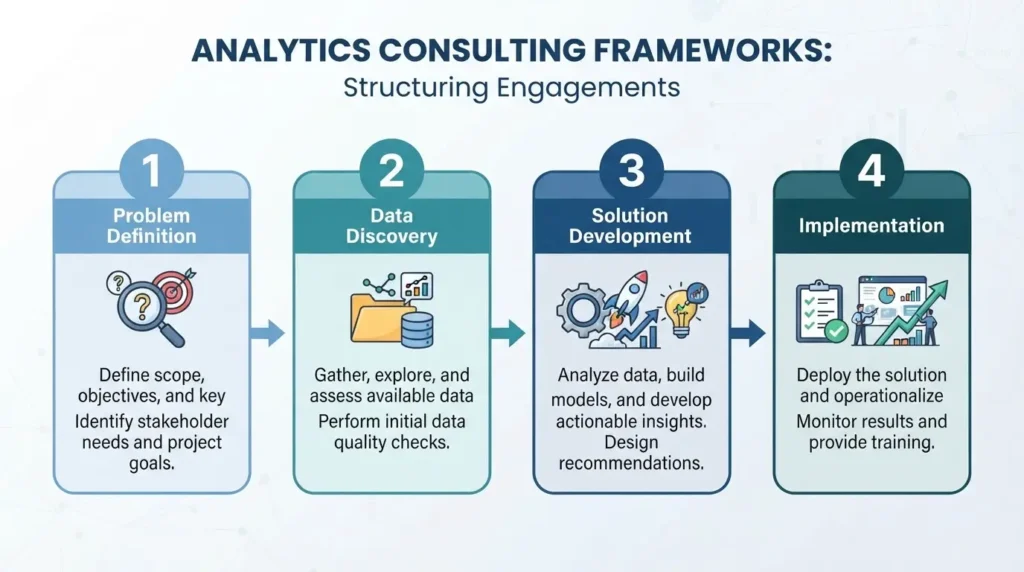
Defining the Problem Before Touching the Data
Every seasoned consultant will tell you that the most dangerous moment in any engagement is the first one — when the client hands over a spreadsheet and says, “Figure out what’s wrong.” Jumping into data before the problem is precisely defined is like performing surgery without a diagnosis.
The first phase of any credible framework is structured problem articulation. This means conducting stakeholder interviews, mapping business objectives to measurable outcomes, and distinguishing between symptoms and root causes. A retail company reporting “declining revenue” might actually be experiencing a customer retention failure in one specific demographic — two entirely different problems requiring two entirely different interventions. Those who pursue a data analytics course with serious intent quickly learn that asking better questions is often more powerful than building better models.
Scoping and Data Architecture: Building on Solid Ground
Once the problem is precisely framed, the framework shifts to scoping — defining what data exists, what data is needed, and what gaps remain. This is where many engagements quietly collapse. Data availability assumptions made in boardrooms rarely survive contact with reality. Fields are missing. Systems don’t speak to each other. Historical records are inconsistent.
A strong scoping phase maps all relevant data sources, evaluates quality, establishes a data governance baseline, and aligns on KPIs with business stakeholders. This architecture phase isn’t glamorous, but skipping it guarantees that analysis built on top will eventually crack under its own weight. Professionals who complete a data analyst course in Bhubaneswar or other analytics hubs recognize this phase as foundational — not optional.
Analysis and Modeling: Where the Story Begins to Emerge
With clean data and a clear scope, the analytical work begins. This phase is where frameworks diverge most visibly based on the nature of the problem. Descriptive analytics answers what happened. Diagnostic analytics asks why. Predictive modeling forecasts what will happen. Prescriptive analysis recommends what to do.
Great analytics consultants don’t default to the most complex model — they choose the most appropriate one. A logistic regression that a business team can understand and trust often outperforms a black-box neural network that generates suspicion. The framework should match the model’s complexity to the stakeholder’s capacity to act on it. Clarity creates confidence, and confidence creates adoption.
Insight Communication: The Art of the Handoff
Delivering a 90-slide deck of technically impressive analysis to a leadership team is not the same as delivering insight. The most analytically rigorous engagement fails if decision-makers leave the room confused, unconvinced, or unable to act.
Effective frameworks build communication design into the engagement from day one. Visualizations should be chosen not for aesthetic appeal but for cognitive clarity. Findings should be sequenced around decisions, not around the analyst’s journey through the data. Each recommendation must be paired with a confidence level, a business impact estimate, and an implementation owner. This phase is where a structured data analytics course teaching presentation and stakeholder management proves its real-world value — often more than the technical curriculum does.
Implementation and Feedback Loops: Closing the Loop
Analytics consulting doesn’t end at the recommendation. The most durable frameworks include an implementation layer — piloting solutions, tracking adoption, measuring outcome changes, and feeding results back into the model. This iterative design turns a one-time engagement into a continuous improvement engine. Organizations that build feedback loops into their analytics architecture don’t just solve problems; they develop the institutional reflex to spot them earlier each time.
Those working with a data analyst course in Bhubaneswar -based training programs are now increasingly exposed to this full-cycle thinking — not just the modeling phase, but the entire journey from business question to measurable outcome.
Conclusion: Structure Is the Strategy
Analytics without structure is guesswork wearing a lab coat. The best consultants are not the ones who know the most algorithms — they’re the ones who can hold the tension between business ambiguity and analytical precision, guiding a messy reality toward a clear decision. A well-designed framework is the invisible scaffolding behind every breakthrough insight. It won’t appear in the final presentation, but without it, there would be no presentation worth giving.
For more details, visit us:
Business Name: ExcelR – Data Analyst & Gen AI Course in Bhubaneswar
Address: 3rd Floor, BMC Bhawani Mall, Saheed Nagar, Bhubaneswar, Odisha 751007
Phone Number: 7026017870