The River That Remembers Every Footstep
Envision a river flowing through a forest, transporting with it all the leaves, all the ripples, and all the disturbances caused by animals that had waded through it hours earlier. If you had the ability to interpret that river the way it flows, the patterns of its eddies, and the debris it has collected, you could put together a full account of what took place upstream even though you had never seen it yourself.
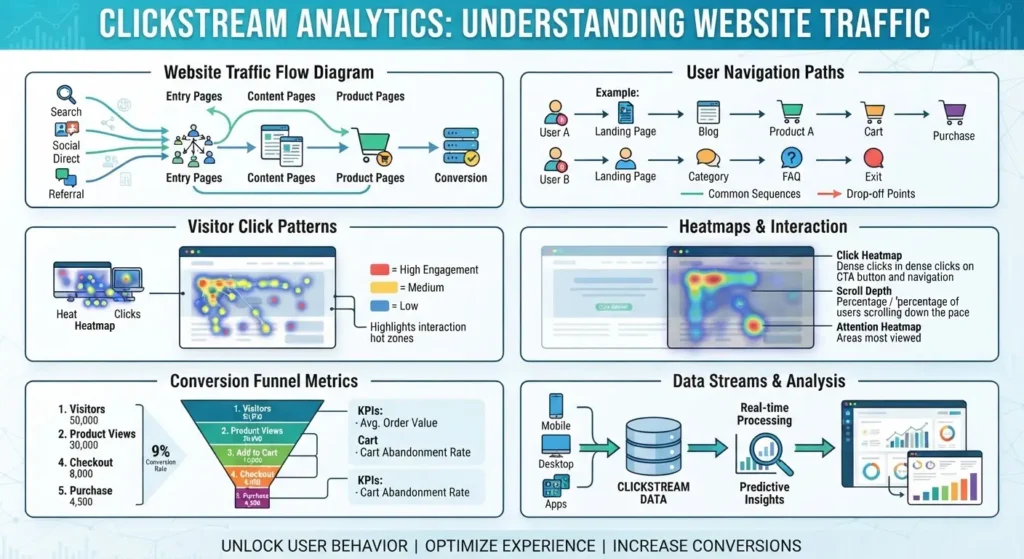
That is exactly the thing that clickstream analytics achieves for a website: each visitor who views a page, pauses on a button, scrolls halfway down the page, or leaves the cart leaves a trace in the digital flow. The practice of clickstream analytics consists of interpreting that stream by following the clicks, the pauses, and the exits in order to not only discover where people went but also to understand why they went there and where they got lost in the process.
This river is unlike a simple visitor counter in that it shows the actual route taken, including the detours and the places where the current suddenly stopped. For businesses that want to make sense of digital behavior, learning to interpret this river is not primarily a technical ability but rather a kind of quiet detective work.
The Current That Never Stops Moving
A website is seldom a static body of water; instead, it is more like a river having many tributaries: the homepage feeding into product pages, blog posts leading on to newsletter signups, and search bars directing traffic into completely unexpected channels. The clickstream data records this continuous movement from one point to another, moment by moment.
A furniture retailer that was operating online observed that its bounce rate was increasing steadily, even though there had been no change to the design of its homepage. Investigation into the clickstream showed the true reason: an increasing proportion of visitors were coming from a price-comparison forum, having expected to find discount codes that were not available on the retail website. The traffic wasn’t faulty; it had simply been arriving via an unexpected source, bringing with it expectations that the site wasn’t set up to fulfill. After the team modified the messaging on the landing page to suit that particular referral source, the number of people leaving the site dropped to a very small amount.
Eddies and Whirlpools: Where Visitors Get Stuck
It isn’t true that all the water in a river flows forward; at times it moves in circles, getting stuck in an eddy and being unable to make its way downstream. On websites, such whirlpools are seen in the case of visitors who keep moving back and forth between the same two or three pages, for example, between a pricing page and an FAQ section without ever making a purchase.
A medium-sized software company identified this pattern by means of its clickstream logs, finding that visitors would keep alternating between the pricing tier comparison and a support article on billing cycles, sometimes doing so six or seven times during one session. The fact that they were circling wasn’t a sign of confusion regarding the product; it showed that they were hesitant about the payment terms. After the company included a straightforward billing summary directly on the pricing page, the circular behavior ceased, and conversions increased within a few weeks.
Sediment and Silt: The Small Signals That Build Big Pictures
A river doesn’t merely transport water; instead, it carries sediment which settles slowly from layer to layer and in the end alters the landscape. Likewise, clickstream data works in the same way: a single click has little significance, but when thousands of clicks are collected over a period of time, they form patterns that show how the whole audience behaves.
The regional news publisher observed that mobile readers always left an article right after the second paragraph, whereas desktop readers continued to read until the end, based on this sediment-like build-up. The one clear insight gained from this, which could not be seen in any individual session, led to a complete change in their mobile content strategy involving shorter opening sections with expandable details afterward.
For people who want to develop this kind of pattern-recognition ability, it is important to have structured learning. A number of analysts improve their skills by taking a special data analyst training in delhi which shows how to progress from raw event logs to real behavioral insight, not merely viewing clickstream data as just another spreadsheet of numbers.
Reading the Riverbed: Turning Data Into Direction
In the end, clickstream analytics is not about admiring the river; it’s about learning how to redirect it. When teams know where visitors stall, loop, or drift away, they can alter the paths by simplifying navigation, rewording the confusing sections, or getting rid of the friction points that quietly drive people away.
It is at this point that the approach changes from one of observation to strategy. To interpret the timestamps, session paths, and exit points, you need more than just a gut feeling; formal training is beneficial, which is why a number of marketing and product teams now have new employees go through a structured data analyst training in delhi before allowing them to use the dashboards without supervision.
Conclusion: Becoming a Careful Reader of the Current
The traffic on a website is never just random noise; it is rather a river having a memory, and clickstream analytics consists of the effort to read it carefully. It is not always the businesses that have the largest number of visitors that succeed, but rather those which are willing to follow each ripple, each eddy, and each layer of sediment left behind by actual human behavior. By doing this, they don’t merely measure their traffic but eventually learn how to direct it.
For more details, visit us:
Business Name: ExcelR – Data Analyst, Gen AI & Agentic AI Course in Delhi
Address: 4th Floor, 10-B, Pusa Rd, Block A, Rajendra Park, Rajinder Nagar, New Delhi, Delhi 110060
Phone Number:917026018552
Email ID: enquiry@excelr.com